

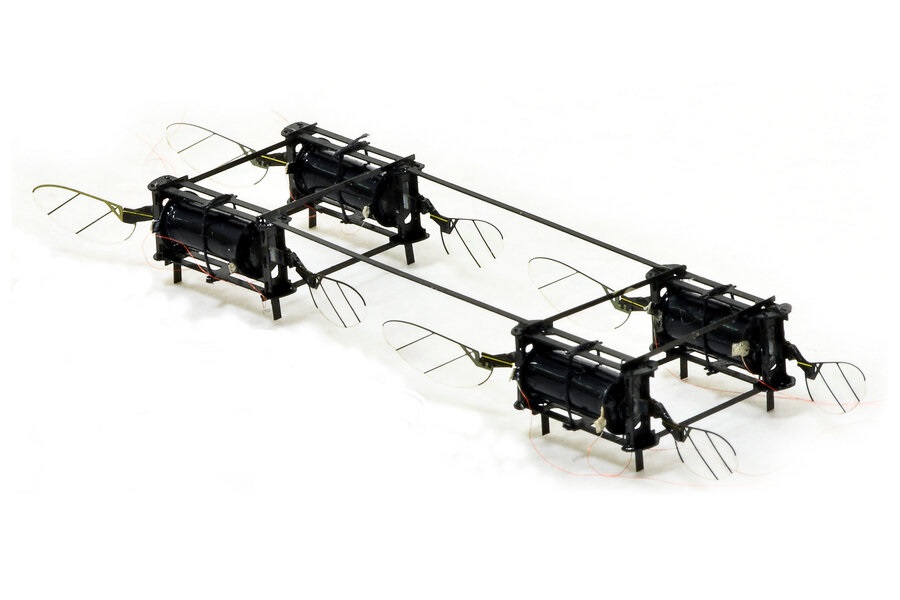
If you’ve ever swatted a mosquito away from your face, only to have it return again (and again and again), you know that insects can be remarkably acrobatic and resilient in flight. Those traits help them navigate the aerial world, with all of its wind gusts, obstacles, and general uncertainty. Such traits are also hard to build into flying robots, scientists have built a system that approaches insects’ agility; insect-sized drones with unprecedented dexterity and resilience. The aerial robots are powered by a new class of soft actuators, which allows them to withstand the physical travails of real-world flight. Scientists hope the robots could one day aid humans by pollinating crops or performing machinery inspections in cramped spaces.
Typically, drones require wide-open spaces because they’re neither nimble enough to navigate confined spaces nor robust enough to withstand collisions in a crowd. If we look at most drones today, they’re usually quite big. Most of their applications involve flying outdoors. The question is: Can you create insect-scale robots that can move around in very complex, cluttered spaces? The challenge of building small aerial robots is immense. Pint-sized drones require a fundamentally different construction from larger ones. Large drones are usually powered by motors, but motors lose efficiency as you shrink them.



The principal alternative until now has been employing a small, rigid actuator built from piezoelectric ceramic materials. While piezoelectric ceramics allowed the first generation of tiny robots to take flight, they’re quite fragile. And that’s a problem when you’re building a robot to mimic an insect—foraging bumblebees endure a collision about once every second.
They designed a more resilient tiny drone using soft actuators instead of hard, fragile ones. The soft actuators are made of thin rubber cylinders coated in carbon nanotubes. When voltage is applied to the carbon nanotubes, they produce an electrostatic force that squeezes and elongates the rubber cylinder. Repeated elongation and contraction cause the drone’s wings to beat—fast. These actuators can flap nearly 500 times per second, giving the drone insect-like resilience. You can hit it when it’s flying, and it can recover. It can also do aggressive maneuvers like somersaults in the air. And it weighs in at just 0.6 grams, approximately the mass of a large bumblebee. The drone looks a bit like a tiny cassette tape with wings, though Chen is working on a new prototype shaped like a dragonfly.
Because of the soft actuators’ inherent compliance, the robot can safely run into obstacles without greatly inhibiting flight. This feature is well-suited for flight in cluttered, dynamic environments and could be very useful for any number of real-world applications. a key step toward those applications will be untethering the robots from a wired power source, which is currently required by the actuators’ high operating voltage.
Building insect-like robots can provide a window into the biology and physics of insect flight, a longstanding avenue of inquiry for researchers. This work addresses these questions through a kind of reverse engineering. If you want to learn how insects fly, it is very instructive to build a scale robot model. You can perturb a few things and see how it affects the kinematics or how the fluid forces change. That will help you understand how those things fly. But they aim to do more than add to entomology textbooks. These drones can also be useful in industry and agriculture.

