

Courtesy: Falcon Autotech
Introduction
In today’s hyper-competitive market, complacency isn’t an option. Companies that fail to adapt risk being left behind. Yet, challenging peak seasons also offer unique opportunities for growth and innovation.




Warehouse Automation – Is it a shift from luxury to necessity?
Warehouse automation leverages advanced technologies to optimise storage, retrieval, sorting, and transportation processes. With the rise of e-commerce and complex supply chains, automation has evolved from a luxury to a necessity.
The warehouse automation market is projected to grow from USD 30.9 billion in 2023 to USD 81.1 billion by 2032, driven by e-commerce and technological advancements. A sub-sect of warehouse automation is the use of robotics for automating warehousing processes. Amidst the e-commerce revolution and the race for faster delivery, warehouse automation (including the usage of robotics in warehouse automation) is shifting from a strategic advantage to an operational imperative.
Trend 1. Automated Storage and Retrieval Systems (ASRS):
Automated Storage and Retrieval Systems (ASRS), a key automation technology, are gaining traction, with adoption rates expected to grow at over 10% annually due to their efficiency in improving space utilisation, reducing labour costs, and enhancing accuracy. In a fast-paced landscape driven by customer demands, ASRS is becoming an integral part of modern warehouses.
Automated Storage and Retrieval Systems (AS/RS or ASRS) are shaping the future of warehouse operations by streamlining storage and retrieval tasks. These systems are a game-changer for industries such as grocery, retail, quick commerce, E-commerce, automotive, and fashion, offering significant improvements in efficiency, space utilisation, and order fulfilment processes. By reclaiming up to 85% of floor space and boosting ROI, ASRS is quickly becoming a must-have for modern warehouses.
A standout example of this technology is Falcon’s NEO ASRS, one of the most advanced goods-to-person (GTP) solutions available today. Successfully implemented in India’s largest sports retailer distribution centre, NEO has delivered some incredible results:
- Achieved 650 units per GTP station per hour for B2B picking operations, setting a new standard in productivity.
- Reduced the storage block area by 60%, making better use of available space.
- Enabled real-time inventory visibility with full tracking of orders and SKUs across the warehouse.
What makes NEO ASRS stand out is its flexibility:
- Any robot can access any bin.
- Any bin can go to any rack location.
- Any robot can work with any Pick/Put station.
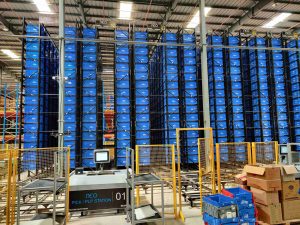
These systems use advanced robotics to deliver fast, accurate storage and retrieval with minimal human involvement. While ASRS adoption has been slower in some regions, it’s finally picking up pace, especially in North America, India, and Europe.
As the technology gains traction, systems like NEO ASRS are leading the way, setting new benchmarks in how warehouses approach order fulfilment and piece-picking operations.
Trend 2. Predictive Maintenance and Safety:
Predictive maintenance uses analytics to proactively identify potential equipment failures before they occur, minimising downtime and improving safety.
Did You Know? Downtime for repairs can account for 1-10% of available production time. Unplanned equipment downtime can cost corporations up to $50 billion per year.
According to McKinsey, predictive maintenance can cut machine downtime by 30-40% while increasing machinery lifespan by 20-40%. Platforms like IBM Watson IoT and Microsoft Azure IoT Suite rely on advanced analytics and machine learning to maintain optimal performance.
Trend 3. AI-Driven Supply Chain Management:
Artificial intelligence is transforming supply chains, reducing costs, and improving service quality. McKinsey reports that AI-powered solutions can cut logistics costs by 15%, lower inventory levels by 35%, and enhance service levels by 65%. While AI-driven robots still need occasional supervision, their efficiency is nearing 90%.
Trend 4. Warehouse Automation for Small Businesses
Despite the common belief that automation is mainly utilised by large enterprises, small-scale companies are gradually adopting these technologies. Models such as Automation-as-a-Service (AaaS) offer affordable entry points, allowing for sustainable growth for smaller businesses. By providing flexible, reconfigurable technologies that adjust to evolving operational needs, AaaS solutions promise positive cash flow.
Trend 5: AMRs & AGVs
The integration of IoT, AI, and computer vision is enhancing mobile robots’ capabilities, particularly Automated Guided Vehicles (AGVs) and Autonomous Mobile Robots (AMRs). These robots dominate the market, with 53% of all warehouse robotics demand in 2022.
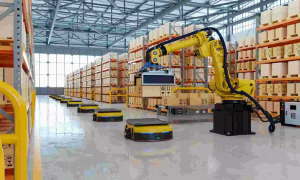
AMRs and AGVs are the go-to warehouse robotics choices for retail, food and beverage industries, as these technologies are highly adaptable to fluctuating market dynamics and are robust enough for on-the-fly demands.
Trend 6: Collaborative Robots (Cobots)
Designed to work alongside human workers, cobots enhance efficiency in repetitive and labour-intensive tasks, bridging the gap between full automation and manual labour. Collaborative robots are cost-effective, safe, and flexible to deploy. Collaborative robots – or cobots – are making automation easier than ever, even for small and mid-sized companies.

Some common (and mind-numbing) repetitive tasks cobots have successfully taken over are palletising and screw-driving. Humans can now use this extra time for tasks requiring higher-order thinking skills, such as troubleshooting complex issues and developing innovative solutions. Though currently a smaller market segment, cobots are growing rapidly with a CAGR of 14.3%.
Other warehousing trends to look out for:
- Cloud-Based WMS: The shift to cloud-based Warehouse Management Systems (WMS) is empowering real-time decision-making and operational flexibility.
- Enhanced Barcode Technology: Advanced barcode systems integrated with robotics and AI will streamline inventory management, ensuring faster and more accurate data capture.
- AI and Vision Systems: AI-driven robots equipped with vision systems enhance operational efficiency by automating sorting, picking, and placing tasks. For example, NEO ASRS NEObots are equipped with 360 Degree LiDAR and can navigate the entire grid fully autonomously and complete pick and put tasks at high speeds. These technologies enable robots to adapt to complex environments, reducing errors and improving productivity.
- Green Logistics and Supply Chain Sustainability: Businesses globally are under increasing pressure to adopt eco-friendly solutions to meet regulatory requirements, reduce environmental impact, and cater to the rising consumer demand for sustainability.
Warehouse Robotics Market Size and Growth:
The global warehouse robotics market is projected to grow from USD 7.93 billion in 2024 to USD 17.91 billion by 2029, at a CAGR of 17.70%. This surge is fueled by the increasing demand for automated solutions capable of handling diverse Stock Keeping Units (SKUs) and the rapid expansion of e-commerce. (Source: Mordor Intelligence)
Top Warehouse Robotics Applications and Benefits
- Picking and Placing: Accounting for 34% of robotic deployments, this function generated USD 1.8 billion in 2022 and is projected to hit USD 4.5 billion by 2030. (Source: Statzon)
- Palletising, Sorting, and Transportation: Together, these applications contributed USD 3.8 billion to market revenue in 2022.
Key Drivers of Warehouse Automation and Robotics
1. E-Commerce Boom:
The rapid growth of e-commerce continues to be the leading force behind warehouse automation. Major players like Amazon reportedly ship 1.6 million packages daily, with volumes surging even higher during peak seasons like Black Friday and Cyber Monday. To keep up, automated sortation solutions become indispensable, operating around the clock and delivering throughput rates exceeding 24,000 parcels per hour (PPH) with uptime as high as 99.7%.

This unrelenting demand shows no signs of slowing, presenting logistics providers with immense operational challenges that only advanced automation can resolve.
2. Sustained Growth in CEP
Even without the e-commerce boom, the global parcel volume, encompassing B2B, B2C, C2C, and consumer-consigned shipments, is projected to reach a staggering 220-262 billion parcels by 2026, exhibiting a robust 14.8% CAGR from 2020 to 2024.

With the global population expected to hit 8.2 billion by 2024 (Source: UN), the staggering parcel volume—nearly 27 times the world’s population—underscores the inevitable adoption of warehouse robotics and automation in the logistics industry.
3. Urgent need for warehousing real estate
And if the volume of parcels is so huge, where do you think it’s supposed to be stored during transit? By 2025, the U.S. alone will require an additional 1 billion square feet of warehouse space.
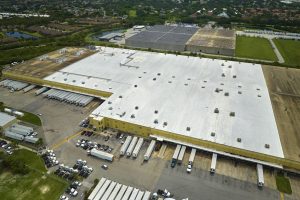
According to Interact Analysis, over the next six years, 50,000 new warehouses, each spanning over 50,000 square feet, will be constructed. To optimise operations within these facilities, a projected 4 million robots will be deployed, with at least 25% of the warehouse space dedicated to online fulfilment.
4. Shifting Dynamics in Supply Chain Models:
The traditional large-pallet order system is being replaced by small, multi-SKU orders due to just-in-time ordering and direct-to-consumer models. This shift necessitates automation solutions like 3D AS/RS systems, which optimise storage and labour resources.
5. Capital Investments and Innovations:
Companies are heavily investing in robotics and automation. Notable examples include:
- Delhivery (India’s largest fully integrated logistics provider) invested an undisclosed amount and increased stakeholder ship of 39% in Falcon Autotec, which proves the immense potential of automation and robotics in the Indian logistics industry.
- Amazon’s USD 40 million investment in a robotics innovation hub in Massachusetts (2019).
- Shopify’s acquisition of 6 River Systems for USD 450 million expanded its fulfilment capabilities with collaborative robots (2019).
- Honeywell’s USD 50 million investment in a Robotics Innovation Hub (2019).
6. Workforce Concerns and Safety:
While automation enhances efficiency, it raises critical questions about workforce displacement and safety in automated environments. Companies like Amazon emphasise the collaborative role of humans and robots, while Ocado leans toward full automation, reducing labour costs by up to 40%.
Conclusion
As we look toward 2025, the evolving landscape of warehouse automation and robotics offers an extraordinary opportunity for businesses to redefine their operations. By integrating cutting-edge technologies like AI-driven supply chain management, collaborative robots, and predictive maintenance tools, organisations can enhance efficiency, reduce costs, and build resilient supply chains.

