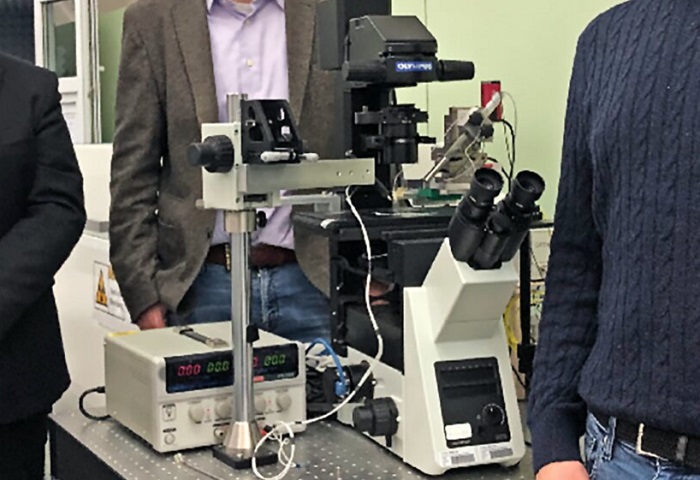
- Researchers at TU Wien have developed a novel method that is suitable for the mechanical tensile testing of micro and nanofibers. The special feature: Samples can be reversibly coupled to and uncoupled from the force sensor.
- Testing the stiffness or tensile strength of fibers in the nano to micro range experimentally is often very time-consuming. The samples in most cases have to be affixed using adhesive on both ends. The curing of the adhesive takes time, and the sensor to which the fiber is glued cannot be reused.
- Researchers from TU Wien, Mathis Nalbach, Philipp Thurner, and Georg Schitter, have developed a test system that overcomes these obstacles. The functional principle is as follows: A magnetic microsphere attached to the nanofiber can be picked up with magnetic tweezers. This allows the sphere to be inserted into the fork attached to a force sensor and thereby coupled to the sensor. Since the magnetic sphere can also be removed from the fork using the magnetic tweezers, another nanofiber can be picked up immediately. This significantly increases the sample throughput.
- Adapted to the real conditions
- While the atomic force microscope can be used to examine the mechanical properties of fiber by means of a nano-penetration test, the NanoTens enables material testing for fibers under the more relevant, tensile load. Philipp Thurner from the Biomechanics research department explains the working principle as follows: “You can imagine the device like a microscopic forklift. The magnetic ball, which is glued to the fiber, is inserted into the fork. By moving the fork up or down, the fiber can now be tested under tensile load. This type of load is particularly relevant for biological fibers such as collagen fibrils. Physiologically, these are mainly loaded under tension, and therefore their mechanical properties are particularly relevant under precisely this load.”
- The biomechanists Nalbach and Thurner mostly examine natural fibers such as collagen. Since their mechanical properties depend strongly on external conditions, it is important to also take these into account in tensile testing. “We succeed in this because tensile tests can be carried out in different media with the NanoTens. A dry collagen fiber, for example, is much more brittle and stiff than a moist or fully hydrated one. Its diameter also decreases significantly when it is dried out,” says Mathis Nalbach, first author of the study.
- Quality and quantity increase
- With their method, the researchers not only succeed in simulating physiological conditions, but the results generated with NanoTens also gain validity. This is because a large number of measurements are needed to obtain meaningful results on biological materials such as collagen fibrils. “Conventional methods allow us to examine only one or two samples per week. This makes it virtually impossible to conduct statistically meaningful studies,” describes Nalbach. Philipp Thurner adds: “The new method allows the fibers to be connected and disconnected quickly. As a result—and because the sensor is reused—we can not only increase the number of tensile tests to up to 50 measurements per week but also the precision of the measurement.”
- The tensile tests can—depending on the choice—be carried out over a wide force range and manipulated via a control system. This is important because tensile test methods normally assume that the material has linear elastic properties. However, this is not the case with biological tissues, such as collagen fibrils: they are viscoelastic. Force-controlled tensile testing enables the investigation of this viscoelasticity.
- From the invention to the product
- NanoTens has already been internationally patented by the TU Wien. “The next step would be to join forces with industrial partners. We hope to find a licensee with the help of research and transfer support. We are interested in cooperating with industry on this topic,” says Mathis Nalbach. NanoTens is designed in such a way that it can generally be integrated into any indentation measuring device or atomic force microscope. In addition to materials science, tensile testing is also used—among others—in the life sciences, semiconductor technology, and electronics.
Novel way for the Mechanical Tensile Testing of Micro and Nanofibers