
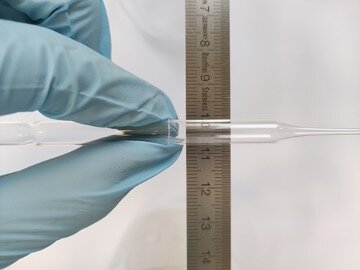
Due to their very high efficiency in transporting electric charges from light, perovskites are known as the next-generation material for solar panels and LED displays. A team led by Dr Lei Su at the Queen Mary University of London now have invented a brand-new application of perovskites as optical fibers.
Optical fibers are tiny wires as thin as a human hair, in which light travels at a superfast speed—100 times faster than electrons in cables. These tiny optical fibers transmit the majority of our internet data. At present, most optical fibers are made of glass. The perovskite optical fiber made by Dr Su’s team consists of just one piece of a perovskite crystal. The optical fibers have a core width as low as 50 μm (the size of a human hair) and are very flexible—they can be bent to a radius of 3.5 mm




Compared to their polycrystal counterparts, single-crystal organometallic perovskites are more stable, more efficient, more durable and have fewer defects. Scientists have therefore been seeking to make single-crystal perovskite optical fibers that can bring this high efficiency to fiber optics.
Dr Su, Reader in Photonics at Queen Mary University of London, said, “Single-crystal perovskite fibers could be integrated into current fiber-optical networks, to substitute key components in this system—for example in more efficient lasing and energy conversions, improving the speed and quality of our broadband networks.”
Dr. Su’s team were able to grow and precisely control the length and diameter of single-crystal organometallic perovskite fibers in liquid solution (which is very cheap to run) by using a new temperature growth method. They gradually changed the heating position, line contact and temperature during the process to ensure continuous growth in the length while preventing random growth in the width. With their method, the length of the fiber can be controlled, and the cross-section of the perovskite fiber core can be varied.
In line with their predictions, due to the single-crystal quality, their fibers proved to have good stability over several months, and a small transmission loss—lower than 0.7 dB/cm sufficient for making optical devices. They have great flexibility (can be bent to a radius as small as 3.5 mm), and larger photocurrent values than those of a polycrystalline counterpart (the polycrystalline MAPbBr3 milliwire photodetector with a similar length).
Dr Su said, “This technology could also be used in medical imaging as high-resolution detectors. The small diameter of the fiber can be used to capture a much smaller pixel compared to the state of the art. So that means by using our fiber so we can have the pixel in micrometer scales, giving a much, much higher resolution image for doctors to make a better and more accurate diagnosis. We could also use these fibers in textiles that absorb light. Then when we’re wearing for example clothes or a device with these kinds of fiber woven into the textile, they could convert the solar energy into electrical power. So we could have solar-powered clothing.”

