
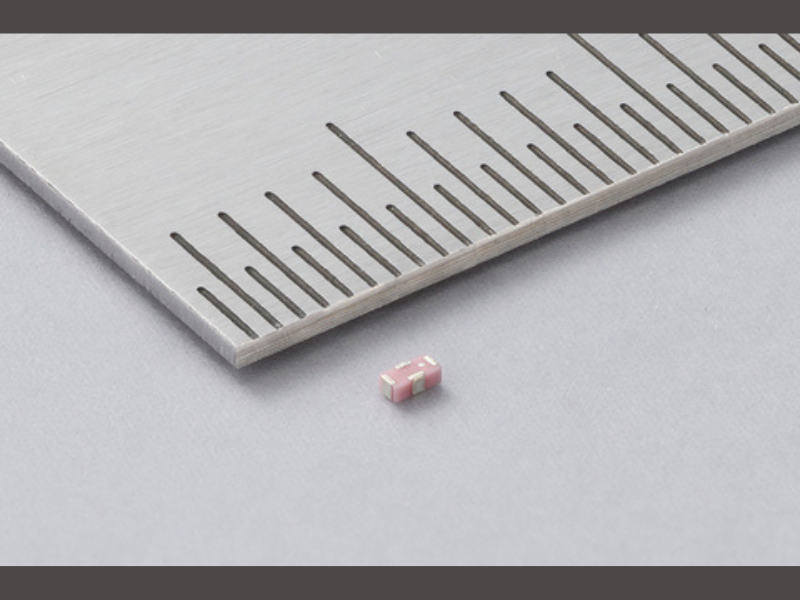
In a groundbreaking development, Murata has introduced the world’s first Parasitic Element Coupling Device, a cutting-edge technology designed to boost antenna efficiency through magnetic coupling with the parasitic element. Tailored explicitly for Wi-Fi 6 E and Wi-Fi 7 products, this innovative solution is set to revolutionize antenna design for electronic devices.
Measuring a mere 1.0 x 0.5 x 0.35mm, Murata’s Parasitic Element Coupling Device employs multilayer technology as a compact four-terminal surface-mount component. Ideal for smartphones, tablets, network routers, game consoles, and various electronic devices, this device allows designers to construct more efficient antennas—a critical requirement for contemporary gadgets.




The technology establishes a more effective connection between the feeding antenna and its parasitic elements compared to free space coupling. Despite its compact size, this tiny coupling device achieves robust coupling performance without relying on magnetic materials, ensuring suitability for the targeted operating frequencies.
With minimal insertion loss, one side of the coupling device connects between a device’s RF circuitry and its main antenna, while the other side links between the ground and the parasitic element. This enhanced coupling enables the resonance characteristics of the parasitic element to complement those of the feeding antenna, facilitating more efficient operation across a broader frequency range or on multiple discrete bands.
The Parasitic Element Coupling Device addresses challenges encountered when antennas are scaled down, ensuring reduced coupling between the antenna and parasitic elements and increased coupling between the parasitic elements and the ground. By maintaining effective coupling between the feeding antenna and parasitic element, designers can employ miniaturized antenna design methods without compromising communication band efficiency.
Beyond its impact on antenna scaling, the device also tackles impedance mismatch issues associated with wide-band antenna usage. Moreover, it addresses concerns arising from connecting antennas with mismatched impedance to communication circuits using long cables. Long cables can exacerbate impedance mismatches, leading to higher-than-expected insertion loss and significantly reduced wireless communication performance. By incorporating Murata’s Parasitic Element Coupling Device, users can enhance antenna matching, minimizing performance degradation in wireless communications, even when utilizing extended cables.
Murata’s latest technological innovation marks a significant leap forward in the realm of antenna design, offering a promising solution to challenges faced by designers and manufacturers in the ever-evolving landscape of electronic devices and wireless communication.

