
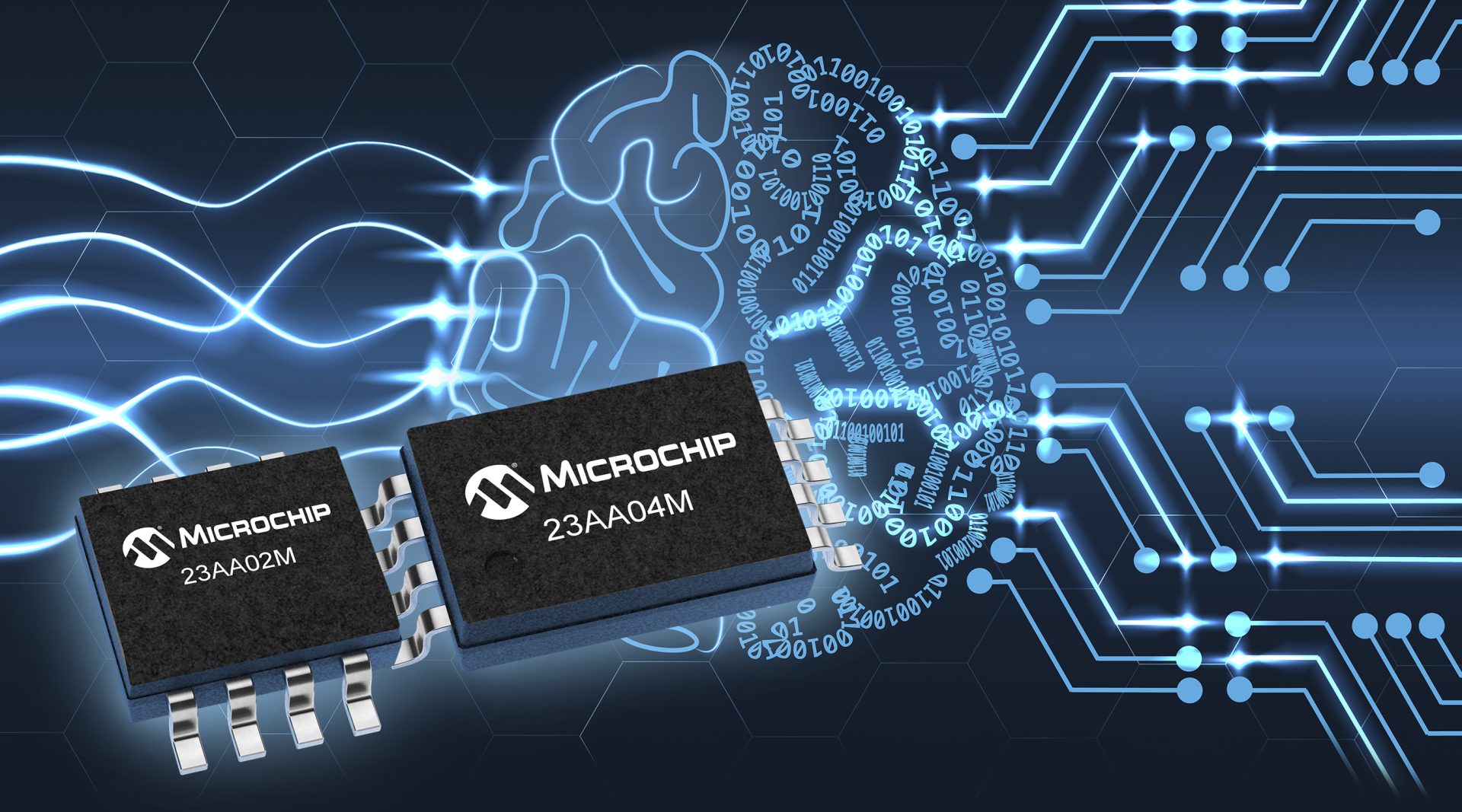
Product line offers a lower-cost alternative to parallel SRAM with up to 4 Mb density and 143 MHz SPI/SQI communications
To address a common customer need for bigger and faster SRAM, Microchip Technology has expanded its Serial SRAM product line to include larger densities of up to 4 Mb and increased Serial Peripheral Interface/Serial Quad I/O Interface (SPI/SQI) speed to 143 MHz. The 2 Mb and 4 Mb devices are designed to provide a lower-cost alternative to traditional parallel SRAM products and include optional battery backup switchover circuitry in the SRAM memory to retain data on power loss.




Unlike parallel RAM, which requires large packages and at least 26–35 microcontroller (MCU) I/Os to interface, the Microchip serial SRAM devices come in a lower-cost, 8-pin package and utilize a high-speed SPI/SQI communication bus that only requires 4−6 MCU I/O pins for easy integration. This reduces the need for a more expensive, high-pin-count MCU and can help minimize the overall board footprint.
Addressing the most common drawback to serial SRAM—that parallel is faster than serial memory—the 2 Mb and 4 Mb serial SRAM devices have increased the bus speed capability to 143 MHz with optional quad SPI (4 bits per clock cycle), which greatly minimizes the speed gap between solutions.
“Serial SRAM is a popular solution for engineers who need more RAM than what is available on board their MCU but are looking to reduce cost and overall board size,” said Jeff Leasure, director of Microchip’s memory products business unit. “Microchip’s 2 Mb and 4 Mb serial SRAM devices are intended to replace expensive parallel SRAM with an easy and cost-effective alternative.”
The small-form-factor, low-power, high-performance serial SRAM devices have unlimited endurance and zero write times, making them excellent options for applications involving continuous data transfer, buffering, data logging, metering and other math- and data-intensive functions. These devices are available from 64 Kbit up to 4 Mb in density and support SPI, SDI and SQI bus modes. Visit Microchip’s Memory Products page to learn about the company’s full portfolio of memory devices.

