
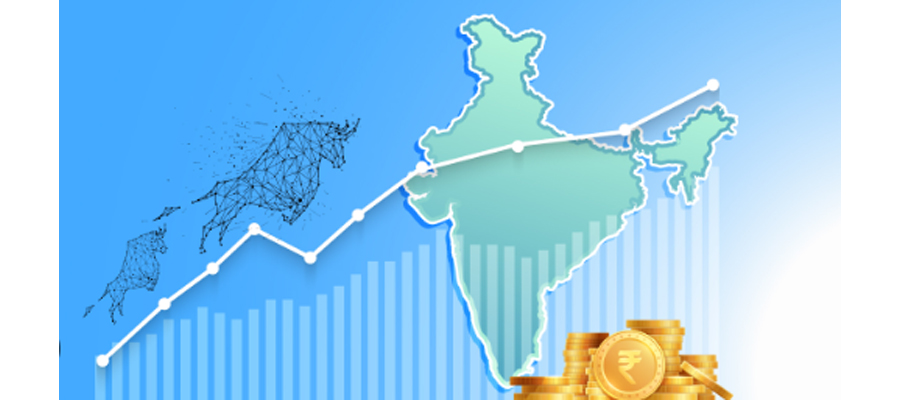
We strongly believe that India will develop all the requisite national strengths that will make it a leading power in the times to come. In the last ten years India has seen robust growth – thanks to its sweeping reforms, focus on capital expenditure, infrastructure development, Make in India initiative, emphasis on self-reliance, Ease of Doing Business and socio-economic reforms.
It would be eminent to see the third term of Prime Minister Narendra Modi, as a coalition government, as how fast he bangs on the self-imposing target of making India a developed country by 2047.




When Modi became prime minister in 2014, India was the tenth largest economy in the world. Today, it has achieved fifth position. What might India and the world expect from a “Modi 3.0” in terms of economic priorities. From being part of the Fragile Five to the Top Five, the Indian economy has emerged as among the top-performing economies among its peers. The government has indeed taken a slew of measures to spur the entrepreneurial spirit in the country.
The following are some of the likely economic priorities for Modi 3.0.
Intensified efforts to grow India’s footprint in global value chains, including in pharmaceuticals, medical devices, electric vehicles, green energy, and electronics.
The government will likely refine its incentives—including the flagship production-linked incentives. Policymakers are also likely to continue their trade push, with a free trade agreement. A third term could also involve efforts toward factor market reforms, including a revived push to see through the labor market reforms.
For India to become a developed nation by 2047, the strategy for the next 25 years should focus on strengthening the already existing electronics and semiconductor manufacturing infrastructure.
The government will likely maintain a high budgetary allocation toward initiatives to expand and modernize its infrastructure, including Gati Shakti and the National Logistics Policy. These initiatives will involve the accelerated development and modernization of highways, railways, airports, and ports. The government will also continue building digital public infrastructure (DPI).
The government is likely to maintain its goal of using green energy sources for much of India’s growing energy requirements. Policymakers will seek to continue prioritizing solar—including a massive effort to increase the use of rooftop solar in homes—as well as “green molecules” (hydrogen, ammonia, and methanol), batteries, and electric vehicles.
The government will likely redouble its efforts to represent the voices and interests of the Global South and to obtain a permanent seat on the United Nations Security Council.
India’s economy is expected to become the third largest in the world in the coming years. However, the administration will likely face challenges both abroad and at home as it seeks to keep its economy growing at around 7 percent of gross domestic product per year.
It would be interesting to see how the government tackles the “Ciliation Dharma” with 4-5 NDA partners. We are pretty sure that the things will be sorted out amicably as Indian democracy is mature enough to handle such issues.
Indeed, Modi 1.0 to 3.0, the Odyssey is filled with great expectations, continuous struggle for constructive developments on one hand and on the other a treacherous design to grab the power. But Modi 3.0 has the makings of a transformative term for India and the world.

