
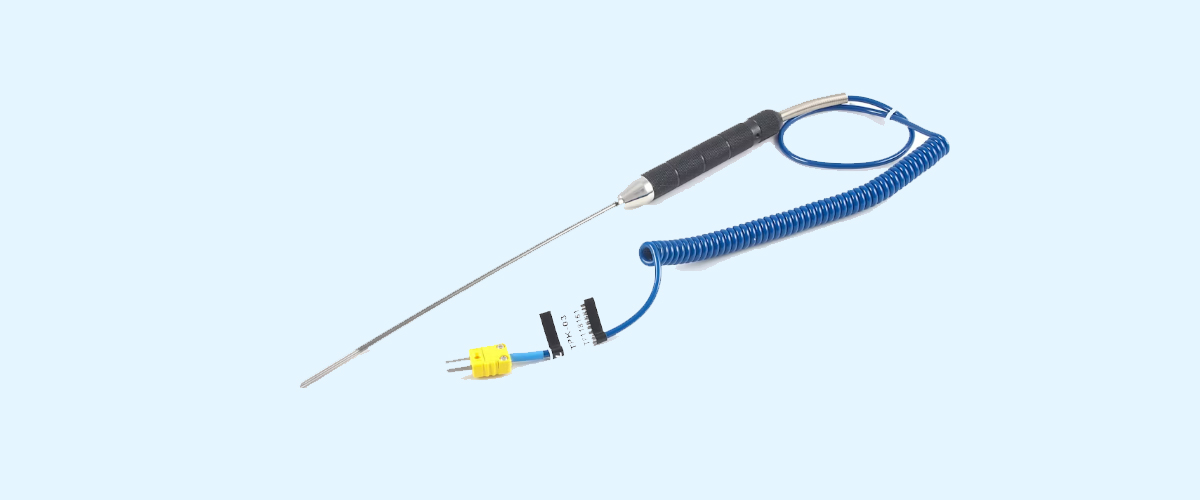
In layman parlance, a thermocouple is a sensor that is used to measure temperature at any point. Be aware, it is different from a thermometer as it uses electricity to measure temperature rather than mercury used inside a thermometer!
What makes a thermocouple?
- A thermocouple is made up of two wires that are made of different metals. The two wires are joined with each other to form a junction at the point of their contact. This junction is called thermocouple junction.
- One end of a wire is placed at the point where the temperature is required to be measured. The end of the other wire is kept at a constant lower temperature.
- A measuring instrument is connected to this circuit at the thermocouple junction. It is calibrated to measure temperature by voltage difference at the junction.
How a thermocouple measures temperature?
- When the end of a wire is placed at the point where the temperature is required to be measured, due to temperature difference with respect to the end of the other wire placed at a constant lower temperature, a temperature gradient is generated.
- The temperature, that is, thermal energy, at the end of the wires, is converted into electrical energy due to thermoelectric effect.
- Due to temperature gradient at the end of the two wires, a voltage, corresponding to the temperature gradient, is generated in the circuit. This happens due to Seebeck effect.
- Seebeck effect stipulates that when two different metal wires are joined at the two ends to form a loop, a voltage is developed in the circuit corresponding to the temperature gradient at the two ends.
- The generated voltage is measured at the thermocouple junction by a measuring instrument that has been calibrated to read the voltage generated corresponding to the temperature gradient at the two ends. This way, temperature at any point can be measured.
Types of thermocouple –
Thermocouples are classified on the basis of two different metals, used to make two wires that constitute a thermocouple.




- First, type E– one metal is nickel or chromium and the other is constantan.
- Second, type J. In this type, one metal is iron and the other is constantan.
- Third, type N. This type uses metals that are nickel-chromium-silicon alloys, one is doped with chromium and the other with magnesium.
- Fourth, type B. In this type, metals that are platinum-rhodium alloy are used. One metal is a platinum-rhodium alloy with 30% rhodium and the other is a platinum-rhodium alloy with 6% rhodium.
- Fifth, type K. In this type, one metal is an alloy of 95% nickel, 2% aluminium, 2% manganese and 1% silicon, whereas the other is an alloy of 90% nickel and 10%chromium, by weight.
- Sixth, type M– one metal is an alloy of 82% nickel and 18% molybdenum and the other is an alloy of 99.2% nickel and 0.8% cobalt, by weight.
- Seventh, Type T– one metal is copper, whereas the other is constantan.
- Eight, Type R. In this type, one metal is an alloy of 87% platinum and 13% rhodium, by weight, and the other is platinum.
- Ninth, Type S– one metal is an alloy of 90% platinum and 10% rhodium, by weight, and the other metal is platinum.
- Tenth, Type C. In this type, one metal is an alloy of 95% tungsten and 5% rhenium, whereas the other is an alloy of 74% tungsten and 26% rhenium, by weight.
- Eleventh, Type D– one metal is an alloy of 97% tungsten and 3% rhenium, whereas the other is an alloy of 75% tungsten and 25% rhenium, by weight.
- Twelfth, Type G. In this type, one metal is tungsten and the other is an alloy of 74% tungsten and 26% rhenium, by weight.
- Thirteenth, Type P– one metal is an alloy of 55% palladium, 31% platinum and 14% gold, whereas the other is an alloy of 65% gold and 35% palladium, by weight.
Applications of thermocouple
Thermocouples are very accurate in measuring temperature differences. Besides, they measure a wide range of temperature, ranging from −270 °C to 3,000 °C. They are durable and have fast response time.
Hence, they are used anywhere where temperature is required to be measured- diesel engines, kilns, scientific labs, furnaces, thermostat, nuclear reactors, etc.

