

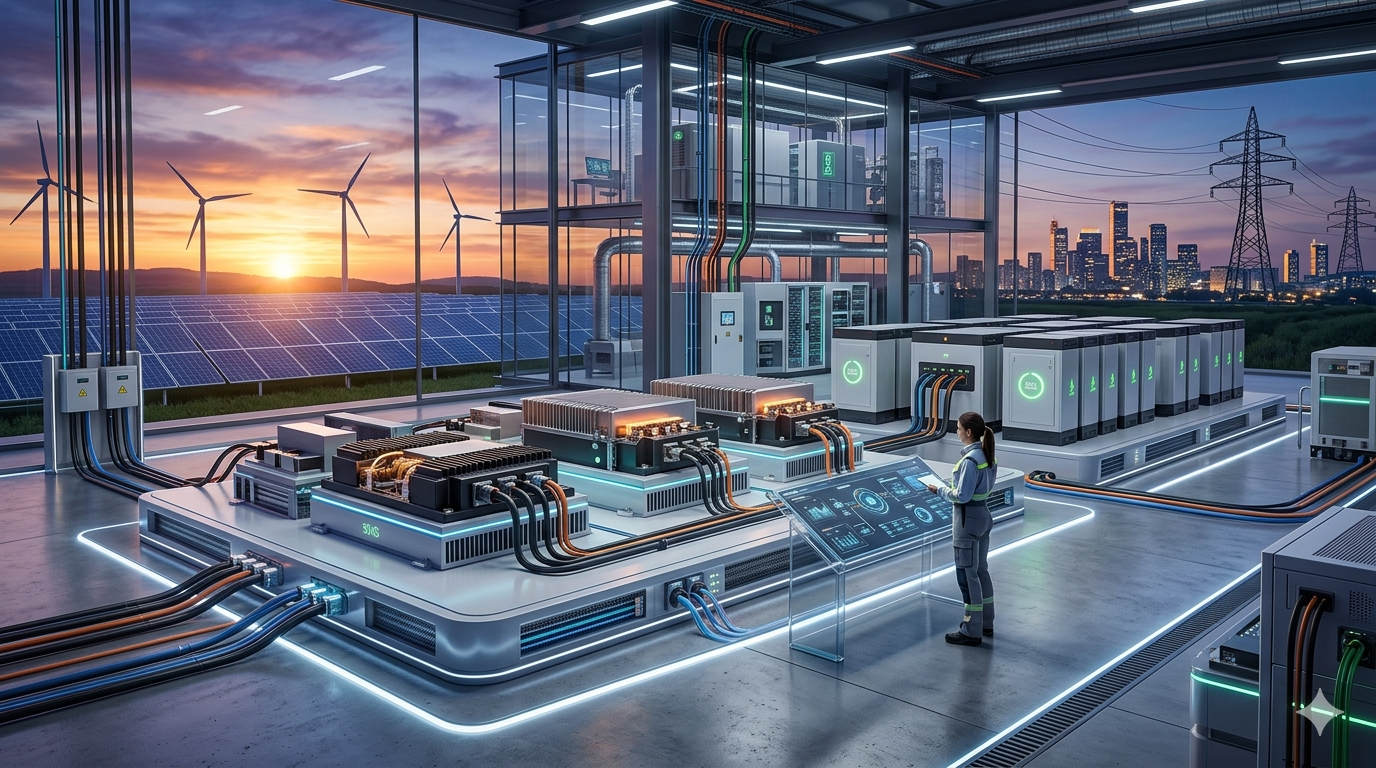
The global power electronics industry is undergoing a major technological transition. For decades, silicon-based devices such as MOSFETs and IGBTs have been the backbone of power conversion systems. However, emerging applications—including electric vehicles (EVs), renewable energy grids, AI data centers, aerospace systems, and ultra-fast charging infrastructure—now demand significantly higher efficiency, power density, switching speed, and thermal capability than conventional silicon can provide.
To overcome these limitations, the semiconductor industry is rapidly adopting Wide-Bandgap (WBG) materials, primarily Silicon Carbide (SiC) and Gallium Nitride (GaN). These advanced semiconductor technologies are redefining modern power conversion architectures and enabling a new generation of compact, energy-efficient electronic systems.



Understanding Wide-Bandgap Semiconductors
The “bandgap” of a semiconductor represents the energy required for electrons to move from the valence band to the conduction band. Conventional silicon has a bandgap of approximately 1.1 eV, whereas SiC and GaN possess much larger band gaps of around 3.2 eV and 3.4 eV, respectively.
This wider bandgap enables several key electrical advantages:
- Higher breakdown electric field
- Lower switching losses
- Faster switching capability
- Higher thermal conductivity
- Operation at elevated junction temperatures
- Reduced conduction resistance
As a result, WBG devices can operate at significantly higher voltages, frequencies, and temperatures compared to silicon devices while maintaining excellent efficiency.
Comparison of Semiconductor Materials
| Parameter | Silicon (Si) | Silicon Carbide (SiC) | Gallium Nitride (GaN) |
| Bandgap Energy | 1.1 eV | 3.2 eV | 3.4 eV |
| Max Junction Temperature | ~150°C | ~200°C | ~200°C |
| Switching Speed | Moderate | High | Very High |
| Breakdown Voltage | Moderate | Excellent | High |
| Thermal Conductivity | Moderate | Excellent | Good |
| Typical Applications | General Power | EVs, Solar, Industrial | Fast Chargers, Telecom |
Silicon Carbide (SiC): The Backbone of High-Power Conversion
Silicon Carbide has emerged as the preferred technology for high-voltage and high-power applications. SiC MOSFETs and Schottky diodes exhibit lower switching losses and superior thermal performance compared to silicon IGBTs.
SiC Power Module Used in EV Inverters
One of the most important advantages of SiC is its ability to switch at very high frequencies while handling voltages exceeding 1200V. This dramatically reduces the size of passive components such as inductors, capacitors, and transformers.
In electric vehicles, SiC traction inverters deliver:
- Higher drivetrain efficiency
- Increased battery range
- Faster charging capability
- Reduced cooling requirements
- Lower system weight
Modern EV manufacturers are increasingly integrating SiC devices into:
- Main traction inverters
- On-board chargers (OBC)
- DC-DC converters
- Fast charging stations
For example, replacing silicon IGBTs with SiC MOSFETs can improve inverter efficiency from approximately 96% to over 99%. Although the efficiency increase appears small numerically, the resulting reduction in thermal losses significantly impacts vehicle range and thermal management.
SiC technology is also critical in renewable energy systems. Solar inverters and wind-turbine converters benefit from higher efficiency and lower heat generation, enabling improved grid stability and reduced operating costs.
Gallium Nitride (GaN): Enabling Ultra-Fast Switching
While SiC dominates high-voltage applications, Gallium Nitride excels in high-frequency, medium-power systems.
Compact GaN Fast Charger
GaN High Electron Mobility Transistors (HEMTs) switch much faster than silicon MOSFETs, often operating in the MHz range. This enables ultra-compact converter designs with extremely high power density.
GaN technology is rapidly expanding in:
- USB-C fast chargers
- Laptop adapters
- Telecom rectifiers
- Server power supplies
- Data-center power architectures
Modern GaN chargers delivering 100W or more are often nearly 50% smaller than equivalent silicon-based chargers. Higher switching frequencies allow the use of smaller magnetic components, directly reducing volume and weight.
Another major advantage is improved efficiency under high-frequency operation. Since switching losses are minimized, less heat is generated, reducing the need for bulky heat sinks.
This is especially important for AI data centers where energy efficiency has become a critical economic and environmental factor.
Why Silicon Is No Longer Sufficient
Traditional silicon devices face several physical limitations in modern high-performance systems:
- Significant switching losses at high frequencies
- Limited high-temperature operation
- Larger cooling systems
- Lower power density
- Reduced efficiency at high voltages
As industries move toward electrification and compact system architectures, these limitations become increasingly problematic.
WBG devices overcome these constraints by enabling:
- Smaller converter footprints
- Higher efficiency
- Reduced cooling infrastructure
- Faster transient response
- Increased reliability
Engineering Challenges of WBG Devices
Despite their advantages, WBG technologies introduce new design challenges for electronics engineers.
Key Challenges Include:
- High device cost
- Fast switching-induced EMI
- Complex gate-driver design
- PCB layout sensitivity
- Thermal stress management
- Packaging reliability
The extremely fast switching edges of GaN and SiC devices can generate severe electromagnetic interference (EMI) if PCB parasitics are not carefully minimized. Engineers must therefore adopt advanced layout techniques, Kelvin-source connections, and optimized gate-drive circuits.
Thermal management also remains a critical design consideration despite improved material performance.
Future Outlook of WBG Power Electronics
Future EV and Renewable Energy Ecosystem
The adoption of Wide-Bandgap semiconductors is expected to accelerate dramatically over the next decade. Industry analysts predict strong growth driven by:
- Electric mobility
- Smart grids
- Renewable energy integration
- Industrial automation
- Aerospace electrification
- AI computing infrastructure
SiC is likely to dominate high-voltage transportation and energy applications, while GaN will become mainstream in compact consumer and communication systems.
For electronics engineers, understanding WBG device physics, high-frequency design techniques, EMI mitigation, and thermal optimization is becoming increasingly essential.
The transition from silicon to Wide-Bandgap semiconductors is not simply an incremental improvement—it represents a fundamental shift in the future of power electronics engineering.

