
HomeTechnologyArtificial IntelligenceDNA-Powered Memory Could Cut Computing Energy Use by 100x

DNA-Powered Memory Could Cut Computing Energy Use by 100x

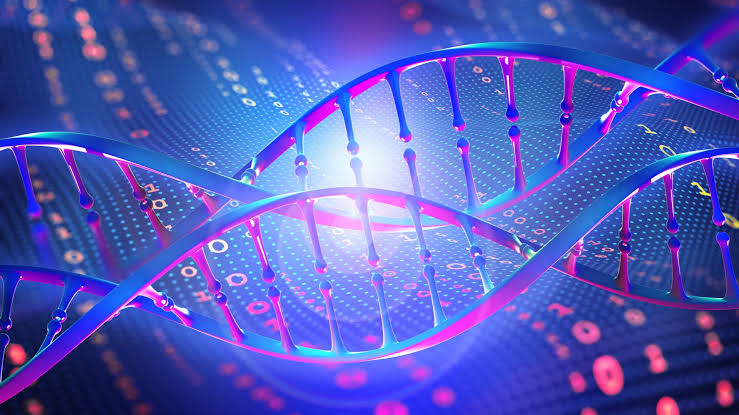
​A team of researchers at Penn State University has now come up with a bio-hybrid device that pairs custom-synthesised human DNA with a perovskite crystalline semiconductor to present a new form of low-power data storage and computation. Their study was published in Advanced Functional Materials in the latest edition released August 17, 2026. Such a device may in time help reduce the energy used for powering AI computing centres and huge data centres, the scientists say.

The technology addresses a growing challenge in modern computing: the enormous energy required to model and process data. An increasing number of high-performance AI workloads and the overall compute and memory demand of data centres mean that there is pressure to find a more efficient way to store and process data.


The researchers used synthetic DNA – a chemically engineered molecule arranged into short molecular sequences and a crystalline perovskite semiconductor material (used in things like solar cells and electronics). The combined pair of these materials created a memristor: a type of electronic memory that retains clues about its past electrical experience.

Such technology could potentially go toward energy-efficient AI-computing hardware; as well as data centres and even the burgeoning field of neuromorphic computing by coupling the storage and processing information within the same device.

The development highlights a broader trend in semiconductor research: instead of relying solely on conventional silicon scaling, researchers are exploring biological materials, memristors and unconventional computing architectures to address the energy and memory demands of next-generation AI systems.

ELE Times Research Desk
ELE Times Research Deskhttps://www.eletimes.ai
ELE Times provides extensive global coverage of Electronics, Technology and the Market. In addition to providing in-depth articles, ELE Times attracts the industry’s largest, qualified and highly engaged audiences, who appreciate our timely, relevant content and popular formats. ELE Times helps you build experience, drive traffic, communicate your contributions to the right audience, generate leads and market your products favourably.

Related News

Must Read

Interview | Narayan Kumar, Chief Business Officer, Panasonic Industry & Energy India

Panasonic Industry has returned to Electronica India this year...

Real-World EV Efficiency: CAA Test Highlights Energy Consumption and Charging Performance

​With the continuously rising demand for electric vehicles, real-world...

Infineon Opens New Bangkok Backend Manufacturing Hub to Expand Semiconductor Capacity

Infineon Technologies on 1st of October, 2026 officially inaugurated...

Delta Electronics and NVIDIA Hyperion to Jointly Advance Level 4 Autonomous Driving

​Moving to advance technology in electric vehicle, Delta Electronics...

India’s Rs 62,500 Crore Mobile Manufacturing Scheme Targets Next Phase of Electronics Growth

​To deepen domestic manufacturing, scale-up its own supply chain,...

Keysight Introduces 20 GHz Dual-Channel Analog Signal Generator for Advanced Device Testing

Keysight Technologies on 1st of October, 2026, announced the...

DigiKey Launches Factory Tomorrow Season 6 on AI Infrastructure and Industrial Connectivity

DigiKey, the global distribution leader in electronic components and...

Rohde & Schwarz FSWX-KM700 Adds Pulse Analysis for DRFM Jammer and Radar Testing

DRFM jammers rely on receiving radar signals, digitizing them...

India’s Semiconductor Market Projected to Reach $200 Billion by 2035: EY-IESA Report

​A new analysis report presented by EY-IESA estimates that...

Vaishnaw Warns India’s Semiconductor Industry of Cyberattacks and Disruptions

​As India emerges as a global supplier in the...

