
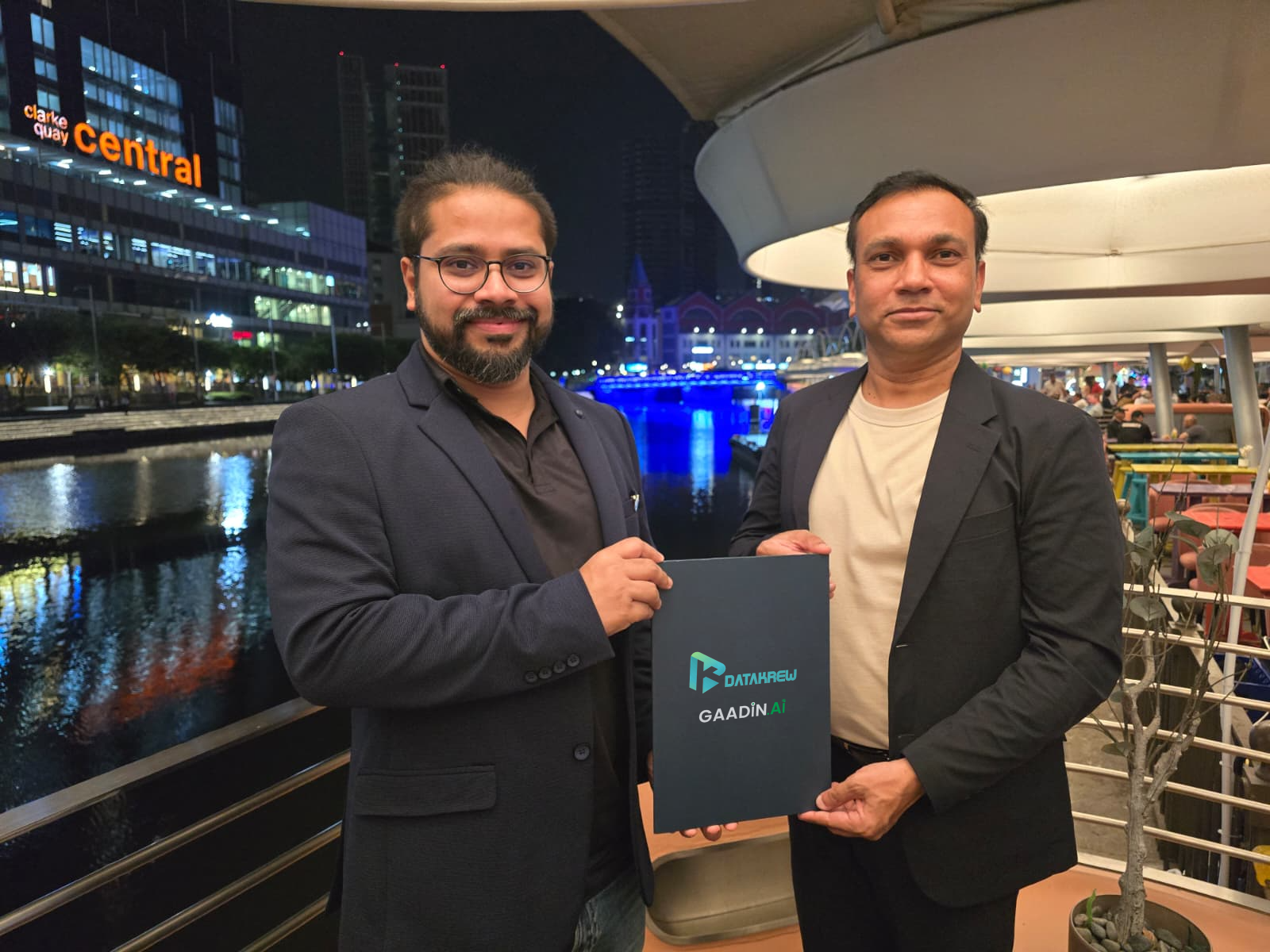
Two complementary market footprints have teamed up to make battery and charging infrastructure more intelligent for EV fleets across India. Datakrew and Gaadin Technologies have signed a Memorandum of Understanding (MoU) to collaborate on integrated EV fleet, battery and charging solutions for customers across their respective markets. The collaboration will combine Datakrew’s EV battery and vehicle intelligence with GaadinAI’s EV charging infrastructure management platform.
The strategy intends to create a more connected operating view for fleet operators, charge point operators and mobility businesses across Asia Pacific, the Middle East, Africa and other markets. Under the collaboration, each company will be able to bring the other’s capabilities into relevant customer opportunities, while also working together where customers require a more integrated view across the vehicle, battery and charging infrastructure.




Connecting the Vehicle and the Charger
As electric fleets scale, vehicle operations and charging operations are increasingly becoming part of the same operating system. Yet in many fleets today, vehicle and battery data sits in one platform while charger, session and energy data sits in another. Operators can see what happened on either side, but often lack the context needed to understand how the two are affecting each other.
That separation matters because charging behaviour influences battery ageing, while battery condition influences vehicle availability, safety, performance and long-term asset economics. Looking at both sides together creates a stronger basis for operational decisions than treating the vehicle and the charging network as independent systems.
The MoU brings together Datakrew’s capabilities in EV battery intelligence, IoT-enabled vehicle data acquisition and AI-driven fleet analytics with GaadinAI’s EV charging management and energy management capabilities. The shared objective is to give customers a more complete operating picture: how a vehicle is being used, how its battery is behaving at cell and pack level, how it is being charged, and how those factors interact over time.
Commenting on the collaboration, Dr. Sumanta Bose, Founder and CEO of Datakrew Pte. Ltd., said, “The vehicle and the charger are often managed as separate systems, but for an EV fleet they are part of the same operating reality. Battery condition is shaped by how the vehicle is driven and how it is charged, while charging decisions are more useful when they are informed by what is happening inside the battery. GaadinAI brings strong EV charging management and energy optimisation with additional market reach, while Datakrew brings the vehicle and battery intelligence layer. Bringing those two views together creates something much more useful for operators than either view in isolation.”
Understanding the Scope of the Collaboration
Under the MoU, Datakrew and Gaadin intend to combine their respective capabilities into integrated offerings spanning EV fleet operations, battery intelligence and EV charging and energy management.
Datakrew will contribute its EV battery and vehicle intelligence capabilities, including state of charge and state of health monitoring, cell-level voltage, current and temperature behaviour, thermal and pack anomaly detection, analysis of the effect of driving patterns and duty cycles on battery condition, and broader vehicle and fleet analytics. These capabilities are delivered through Datakrew’s OXRED platform, with vehicle data acquired through its ITUS Max device family and related integrations.
GaadinAI will contribute its EV charging management and energy management capabilities, including charge point operations across multiple charger vendors, session and energy management, charging network monitoring, and the operational and deployment experience it has built across its markets.
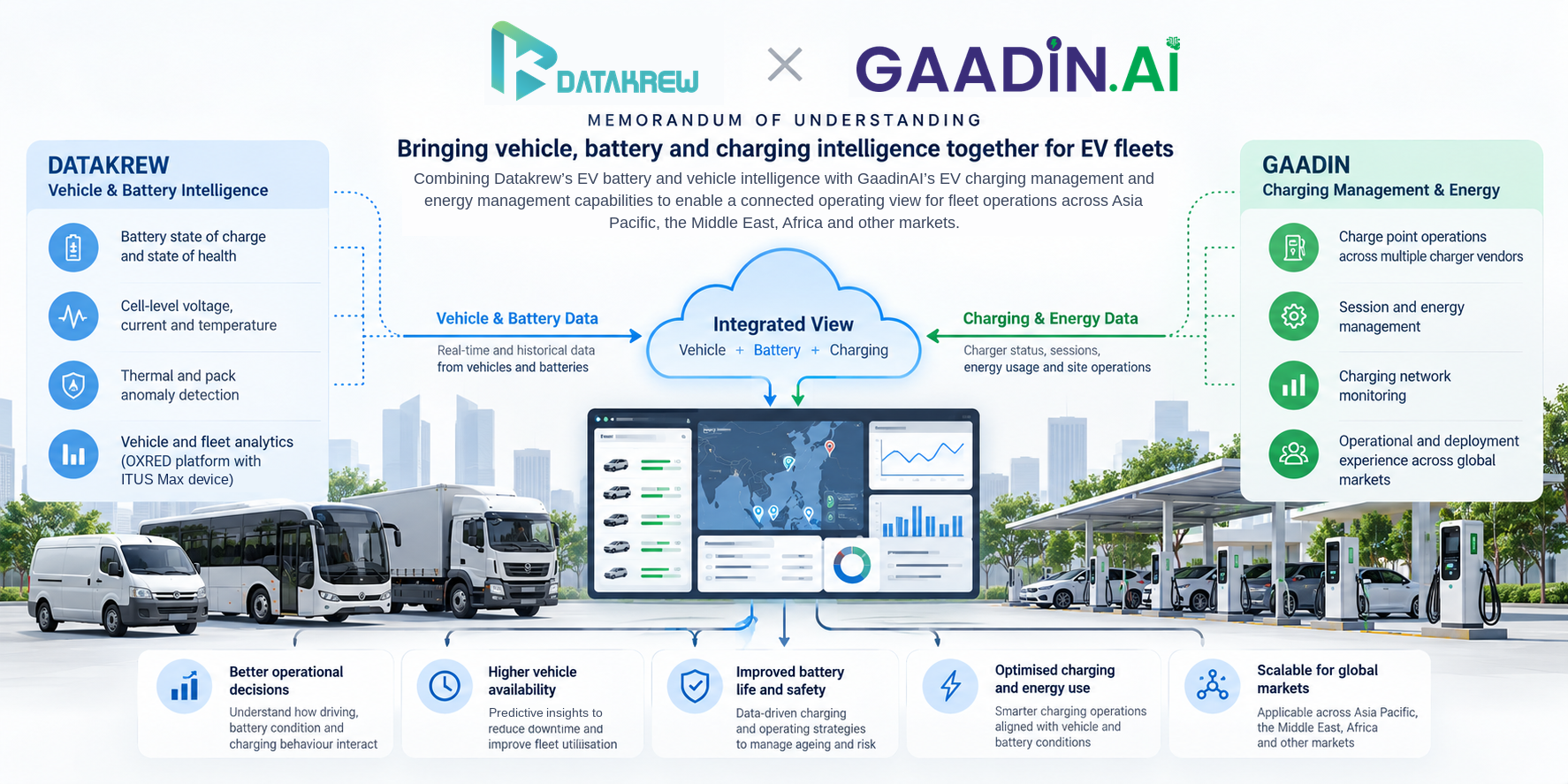
The two companies also intend to make relevant platform interfaces available for integration. This ensures that vehicle-side and charge-side information can be presented to customers as a connected operating view rather than as separate datasets that need to be reconciled manually. Where appropriate, both sides will also support customer engagements with technical and commercial resources from their respective teams.
Commenting on the collaboration, Sanjeev Tripathi, Founder and CEO, Gaadin, said, “As EV fleets scale, the constraint is no longer only charger availability. It is how intelligently those chargers are operated, how energy is managed, and how charging behaviour affects battery life. This collaboration is designed to address that full stack.”
Datakrew and Gaadin: Moving From Deployment to Operations
The EV industry is entering a different phase of maturity. For much of the past decade, the immediate challenge was deployment: procuring vehicles, installing chargers and putting the necessary infrastructure in place. As fleets become larger and more established, the focus is shifting toward operating those assets efficiently over many years.
That shift changes the role of data. During deployment, vehicle systems and charging systems could be managed separately because they were often solving different immediate problems. During long-term operation, however, many of the questions converge. Fleet uptime, charging strategy, battery life, energy cost, maintenance planning and residual value are closely connected, and decisions in one area increasingly influence outcomes in another.
This creates a natural role for collaboration between specialised technology providers. Battery intelligence and charging infrastructure management are both technically deep disciplines, and customers benefit when strong platforms in each area can work together without requiring one provider to replicate the other’s technology. Open interfaces and practical interoperability allow operators to retain flexibility while gaining a more complete view of their electric assets.
The Datakrew–Gaadin collaboration is built around that principle. Each company will continue to focus on its own area of expertise, while making it easier for customers to connect the vehicle, battery and charging layers where there is a clear operational benefit.
What it Means for the Customers
For customers, the value of the collaboration is expected to be operational rather than simply technical. Instead of managing fleet and charging information as separate exports or dashboards, operators can work toward a connected view in which charging sessions, vehicles, batteries and duty cycles can be interpreted together.
That creates the potential for charging decisions to be informed by battery condition rather than by energy demand alone. Over time, operators may be able to make more deliberate decisions about which vehicles are charged, how frequently they are charged, how deeply they are charged and how charging behaviour should vary based on battery condition, route requirements and fleet availability.
The combined view can also help with fault isolation. An unusual charging event can originate from the charger, the vehicle, the battery or the interaction between them. When information from both sides is available together, engineering and operations teams have more context to identify the likely source of a problem and respond appropriately.
The partnership intends to reduce the integration burden on customers. Operators already working with either company may be able to access complementary capability through an existing technology relationship rather than independently sourcing systems and then commissioning a separate integration between them.
Importantly, the collaboration does not require either company to become a full-stack provider. Both platforms remain distinct, giving customers the ability to combine specialised capabilities while retaining flexibility across mixed vehicle fleets and multi-vendor charging environments.
From Complementary Capabilities to a Joint Offering
Datakrew has focused on what happens in the vehicle and inside the battery, while GaadinAI has focused on what happens across the charging network. The areas are closely connected in day-to-day EV operations, but they require different technical capabilities and operating experience. By working together, Datakrew can bring battery and vehicle intelligence into charging-led customer conversations and into markets where Gaadin already has operational presence and relationships.
Gaadin, in turn, can extend the depth of its charging proposition by helping customers understand the condition and behaviour of the vehicle and battery at the other end of the charging session. The commercial model is intended to remain practical. Each company can introduce the other into relevant customer opportunities, and both can pursue joint opportunities where a customer has a clear need spanning the vehicle, battery and charging layers.

