

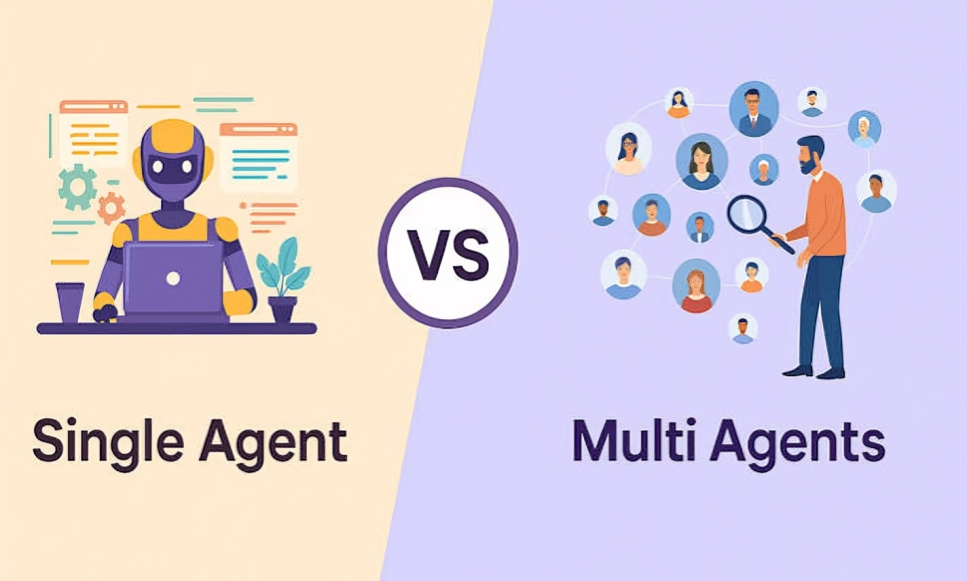
The next phase of AI evolution moves from fact-finding chatbots to a learnable system that can plan tasks, invoke tools, search, and take various steps (workflows). On the leading edge of this evolution are AI agents that utilize LLMs, tools, and context to move toward an explicit goal. When adopting agentic AI, a key architectural decision concerns whether to operate a single agent or manage many specialised agents.
Single Agent vs Multi Agent AI Systems allows organisations to determine the best architecture for their day-to-day activities. Single-agent systems are easier to manage and keep simple, though multi-agent system architectures help split larger workflows among different agents. That said, some people think more agents don’t necessarily mean better results. It all comes down to task type, security, lag, and cost.



Understanding Single-Agent AI Systems
A single-agent AI system has a single primary agent. That agent accepts input, decides what action to take, chooses a tool, and produces an ending result. It can interact with databases, utilize an application programming interface, invoke enterprise knowledge systems, or execute any of the others as it operates. Its architecture includes a language model, the system instructions, the tools you might have, and a context manager. It receives a request, decides what to do next, and observes the result.
For example, a customer service person might check the status of an order, refer to a database of delivery schedules, explain the reason for a delay, and write a response- all in the same conversation without transferring the conversation between different AI agents. The major benefit of single-agent AI design is that it is simple. Developers can tweak the main system prompt, adjust the tool authorizations, trial the model’s behaviour, and observe how it makes decisions.
Although a single-agent approach is preferable when it is capable of fulfilling the requirements, Google Cloud advises deploying a single agent. It can regress when one agent needs to handle too many tools, tasks, or conflicting prompts. These limitations may make it necessary to utilize multi-agent architecture.
What Are Multi-Agent AI Systems?
Multi-agent AI is when multiple agents work together to cooperate on a shared goal. Each of the individual agents might be given different source material, instructions, scope, and access to different tools, and therefore one may do one step. For example, in the flow of a piece of enterprise research, each of the agents might be given a job such as finding info, fact-checking the technical points, assessing the impact on the market, and then writing up the report.
This method is based on AI agent orchestration- initiating tasks, disseminating data, defining interdependencies, and consolidating the results. It is possible to guide the approach or use it on demand, where agents determine their next action.
These patterns are popular:
- Sequential Orchestration: The agents follow a predetermined order, and one agent makes use of the output of the previous one.
- Parallel execution: Completing various components simultaneously could decrease the amount of time to complete the task.
- Coordinate-based architecture: A central agent assigns tasks to specialised agents and pools their results.
- Hierarchical task decomposition: A lead agent breaks down a complex goal into a number of simple goals (possible till being simple enough to be assigned to low agents).
- Collaborative or group-chat architecture: The agent shares outputs, challenges concepts, and iterates on a shared product.
The AI agent’s approach to orchestration explains these patterns and provides an example of how a trade-off exists in terms of the level of coordination, speed, and flexibility for any given deployment.
Single-Agent vs Multi-Agent AI Systems: Key Architectural Differences
The primary difference is in how you slice and dice each responsibility and what decision you’re making. In a single agent design, a single agent takes care of the complete workflow, even when talking to more than one tool. In a multi agent AI system, a set of agents are divided between responsibilities and communicate with each other through orchestration.
Task complexity is also important. Many structured tasks like answering customer questions, summarising documents, information retrieval, and the majority of data analysis can be achieved quickly by a single agent. Multi-agent systems are better if a workflow requires clear specialist roles, planning, or individual investigations.
The scalability and maintenance are also different. Adding new features and new tools can make a single agent system too complex to be manageable. Multi-agent modular systems will allow developers to change a single agent without causing all these implications in the system, as long as the interface or port to the agent is well specified. But multi agent systems also add the problem of additional communication, states, testing, and monitoring.
Cost also matters. A single-agent workflow might be able to use fewer model calls, but a multi-agent workflow could lead to the usage of more tokens and greater computing power. Parallel execution might lower the time taken for completing the task, but will bump up the peak resource consumption. Therefore, organisations need to assess single agent vs multi-agent architecture with actual task success rates, response times, and cost failure rates.
Real-World Use Cases of Single-Agent AI Systems
Single-agent AI use cases are more interesting if that one agent can do a workflow with only a few tools and KBs. Customer service: A single agent could answer a question about a product, find an order, and suggest troubleshooting steps. Productivity tools- summarize a document, search enterprise KBs, prepare for a meeting.
A further application is software development. A coding agent can examine a code repository, create code, execute tests using authorized applications, and make recommendations for repairs. An IT support agent could explore common problems, query monitoring systems, and make recommendations. These applications could take advantage of a fairly simple control structure. Organisations could set up rules for permissions, examine results, and incorporate human approval for critical actions without having to coordinate a large network of agents.
Multi-Agent AI Use Cases Across Industries
Multi-agent use cases are especially valuable when a business process can be achieved using multiple different functionalities. Within financial markets, various specialised agents can gather market information, monitor the risk profile of the portfolio, perform rule checks and make suggestions for actions. Financial transactions and other large transactions should still be subject to correct authorisation and regulation.
Functions might also be linked to, for example, watch sensor data from machinery, view your maintenance history, inventories of spare parts, and support fixing. A chain like this to combine functions would foretell failure and avoid downtime, yet to be safe, devices require suitable deterministic controls with people involved. For instance, one actor reacts to a security alarm, while another deals with connected phenomena, while the other starts compiling a report. Controls will need to restrict and authenticate access, because a wrong conclusion might cause a negative reaction to the incident.
The consequences might be beneficial for other links in the supply chain, too. For example, each agent could review inventory, track records of their suppliers, delays in shipping, and demand forecasts before producing the suggestion to human planners. For publishing and research, agents could handle source discovery, fact-checking, analysis, and writing. The results, however, still need human review, particularly if there are technical claims or fast-charging data.
Challenges, Security and Governance
However, multi-agent AI systems also pose new risks which organisations need to manage before deploying. For example, agents may generate inaccurate information, misinterpret commands, or deliver substandard results to other agents. The presence of several different elements can also make failures harder to track.
Security is crucial when agents have access to business apps, private files, or are equipped with tools that can modify data. Every agent should be assigned the minimum permissions they require. Businesses should verify tool inputs, restrict access to sensitive information, log key activities, and seek human approval for critical decisions.
Another challenge is context management. Agents require useful context to perform their tasks, but more context can add to processing costs and create distraction. Systems should deliver brief, task-specific context between agents, and shared state should be preserved when needed. Testing should test the whole workflow, not just individual agents. Appropriate metrics would be task success and accuracy, tool call error, latency, cost per task success, and human intervention.
Choosing the Right AI Agent Architecture
Choose between a single-agent or multi-agent system based on the task you are trying to solve, and not by the number of agents you want to use. If it’s something within a well-defined, relatively narrow scope and with narrow tool access, and where workload performance can be improved by providing more specific instructions or by designing the workflow, then you should probably want to use a single agent. Multi-agent design is appropriate when responsibilities entail specialised capabilities, isolated security domains, parallel execution, or coordination.
The most pragmatic solution may be to construct and test the simplest architecture capable of achieving the performance requirements; then, assuming that measurable constraints remain, deploy specialised agents and orchestration following. Long-term, the future of an agentic AI architecture isn’t simply about more agents but about more reliable, secure, measurable, and useful ones. For businesses, success will be designing an architecture that’s commensurate with real-world needs and ensures the costs, accountability, and human oversight are all well managed.

