
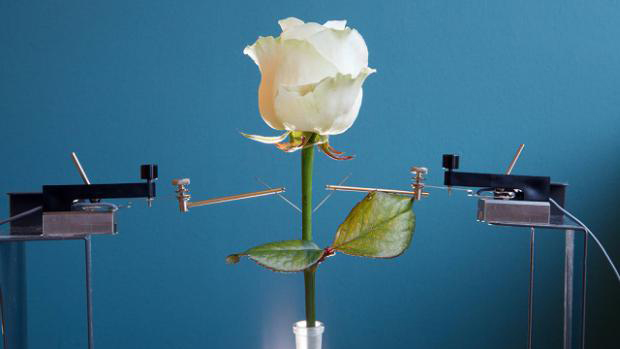
Energy storing is now to smell sweet, as scientists have created a path-breaking system that has maybe surpassed the previous developments.
By transforming a rose into an ‘electronic’ plant, scientists have developed a supercapacitor that may lead to systems harvesting energy from ‘electronic plants’ to power sensors.



In what can most definitely be called a scientific breakthrough, the researchers showed that they had caused roses to absorb a conducting polymer solution. Conducting hydrogel formed in the rose’s stem in the form of wires.
With an electrode at each end and a gate in the middle, a fully functional transistor was created.
“We have been able to charge the rose repeatedly, for hundreds of times without any loss on the performance of the device. The levels of energy storage we have achieved are of the same order of magnitude as those in supercapacitors,” said said Eleni Stavrinidou, assistant professor at the Laboratory of Organic Electronics from Linkoping University in Sweden.
“The plant can, without any form of optimisation of the system, potentially power our ion pump, for example, and various types of sensors,” said Stavrinidou.
Researchers developed a material that polymerises within the rose without any external trigger.
The innate fluid that flows inside the rose contributes to create long, conducting threads, not only in the stem but also throughout the plant, out into the leaves and petals.
“This research is in a very early stage, and what the future will bring is an open question,” said Stavrinidou.
“A few years ago, we demonstrated that it is possible to create electronic plants, ‘power plants’, but we have now shown that the research has practical applications,” said Magnus Berggren, head of the Laboratory of Organic Electronics.
Some examples are autonomous energy systems, the possibility of harvesting energy from plants to power sensors and various types of switches, and the possibility of creating fuel cells inside plants.
The study was published in the journal Proceedings of the National Academy of Sciences (PNAS).

