
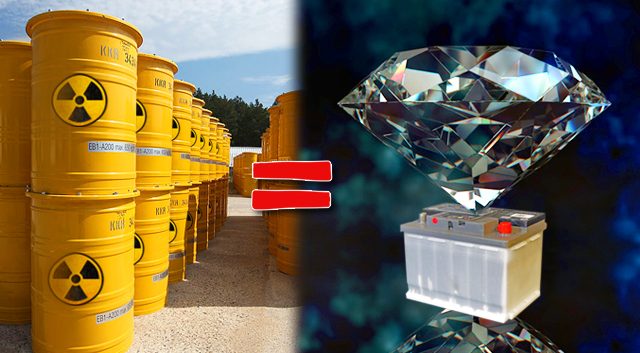
- Diamond produces a charge when placed next to a radioactive source
- There are no moving parts, no emissions and no maintenance is needed
- Scientists believe a battery built in 2016 could last until the year 7746
- Because the radioactive source is encased safely within diamond – the hardest known substance – it would be safe to use, say the researchers
A battery crafted from a new man-made diamond could last for more than 5,000 years, according to new research.
Scientists created the radioactive diamond batteries by converting nuclear waste.




The batteries would be ideal for powering equipment that needs to run reliably for a long time, including pacemakers, drones, satellites and spacecraft.
They say the breakthrough could simultaneously help to the solve the problems of nuclear waste, clean electricity generation and battery life, say the researchers.
Unlike the majority of electricity generation technologies, which use energy to move a magnet through a coil of wire to generate a current, the man-made diamond produces a charge simply by being placed in close proximity to a radioactive source.
‘There are no moving parts involved, no emissions generated and no maintenance required, just direct electricity generation,’ said Tom Scott, Professor in Materials in the University of Bristol’s Interface Analysis Centre.
‘By encapsulating radioactive material inside diamonds, we turn a long-term problem of nuclear waste into a nuclear-powered battery and a long-term supply of clean energy.’
The researchers created a prototype ‘diamond battery’ using radioactive isotope Nickel-63 as the radiation source.
They are now working on improving the efficiency of the device.
To do this, they are using carbon-14, a radioactive version of carbon, which is generated in graphite blocks used to moderate the reaction in nuclear power plants.
The carbon-14 is concentrated at the surface of these blocks, making it possible to process it to remove the majority of the radioactive material.
How it Works:
The man-made diamond produces a charge simply by being placed in close proximity to a radioactive source. There are no moving parts and no emissions involved and no maintenance is needed. The researchers created a prototype ‘diamond battery’ using radioactive isotope Nickel-63 as the radiation source. They are now working on improving the efficiency of the battery. To do this, they are using carbon-14, a radioactive version of carbon, which is generated in graphite blocks used to moderate the reaction in nuclear power plants. The carbon-14 is concentrated at the surface of these blocks, making it possible to process it to remove the majority of the radioactive material. The extracted carbon-14 is then incorporated into a diamond to produce a nuclear-powered battery.

