

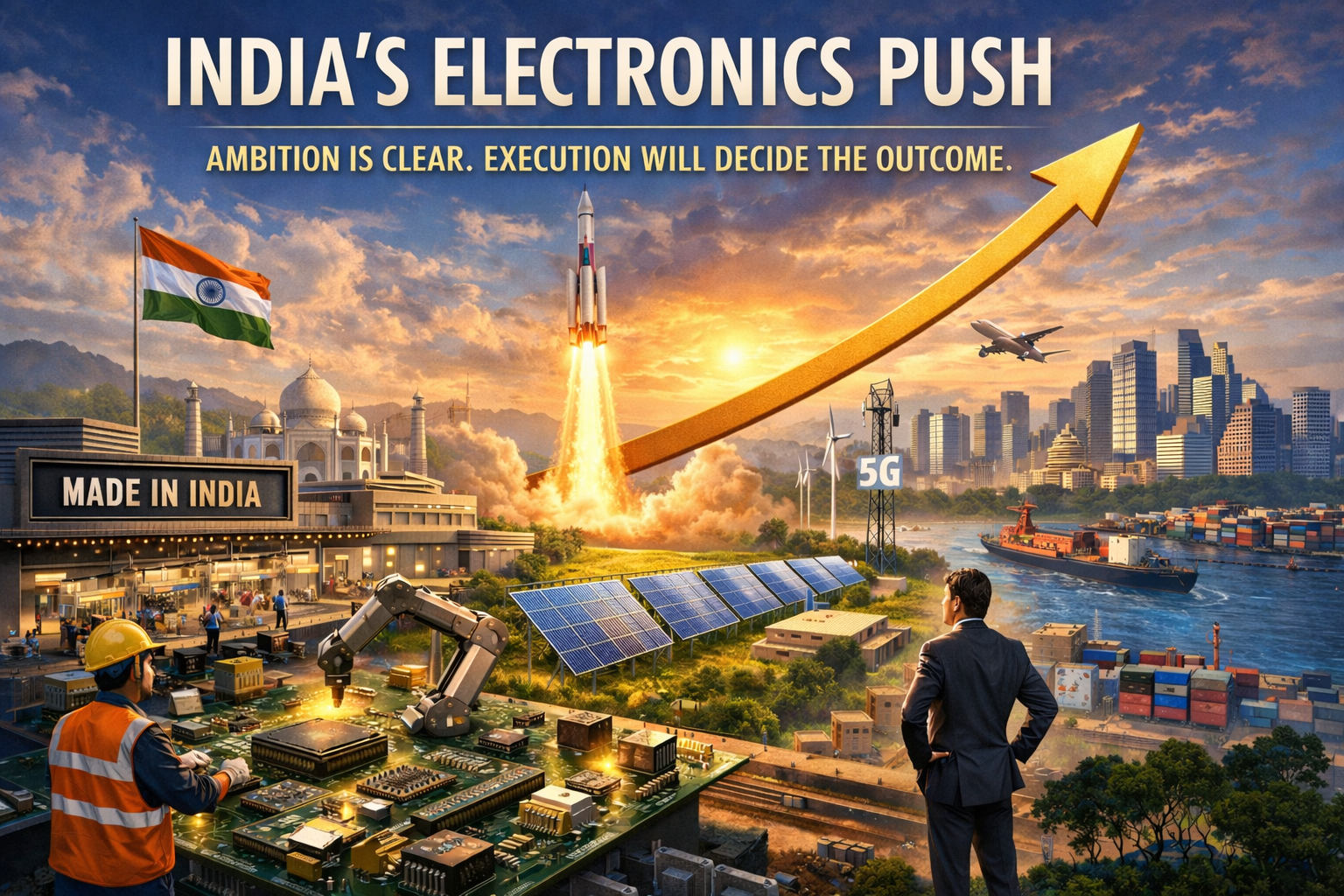
India’s electronics story has entered a decisive phase. The policy announcements of February 2026 — combined with export milestones and strategic partnerships — suggest that the country is attempting something far larger than incremental industrial growth. It is trying to reposition itself in the global technology hierarchy. But ambition alone will not secure that position. Execution will.
The Union Budget 2026–27 allocated ₹40,000 crore to strengthen domestic component manufacturing under the Electronics Components Manufacturing Scheme. This is a necessary correction. For years, India has excelled at assembling finished goods while importing critical components.



Simultaneously, India Semiconductor Mission 2.0 signalled a deeper commitment to building semiconductor capability across fabrication, assembly, and materials. The intent is clear: India does not want to remain at the lower end of the value chain.
The export data reinforces this shift. Smartphone exports have touched roughly $30 billion, with global leaders such as Apple and Samsung Electronics scaling manufacturing operations in India. This is not a small achievement. In less than a decade, India has moved from a peripheral manufacturing base to a meaningful node in global electronics supply chains.
Yet, the central question remains: Is India building depth — or scale without control?
Assembly success does not automatically translate into technological sovereignty. True leverage lies in advanced semiconductor fabrication, high-end equipment manufacturing, precision materials, and ownership of intellectual property. On these fronts, India still trails global leaders by a wide margin.
The partnership between Qualcomm and Tata Electronics in automotive electronics demonstrates progress in value-added manufacturing. But automotive modules, while strategically important, are not the same as owning leading-edge fabrication technology.
There is also a structural reality policymakers must confront: semiconductor ecosystems take decades to mature. They require uninterrupted capital flow, stable policy frameworks, reliable power, water security, efficient logistics, and depth in engineering. Any inconsistency could stall momentum.
The global semiconductor race is no longer an economic contest. It is a geopolitical war — one fought with export controls, subsidy regimes, technology blockades, and supply chain realignments. The United States has weaponised semiconductor policy through export controls and industrial subsidies. China has doubled down on domestic chip independence. Europe is pouring billions into sovereign fabrication capacity. Taiwan remains indispensable. South Korea protects its giants as strategic assets.
Semiconductors have become the oil of the digital century — and nations are securing supply at any cost.
What India is attempting is bold — and necessary. Electronics today underpin defence systems, AI infrastructure, mobility platforms, and digital economies. Countries that control semiconductor depth control strategic autonomy.
The danger is complacency born from export success. Hitting $30 billion in smartphone exports is impressive. But if core chips, advanced lithography systems, and high-value IP remain imported, strategic vulnerability persists.
India’s electronics sector is at a crossroads. The past month shows strong policy intent and rising industrial confidence. The next five years will test whether this momentum can be translated into irreversible capability.
The world is reorganising supply chains. India has an opportunity to claim a durable position. But the window will not remain open indefinitely. Ambition has been declared. Now comes the harder task — building capability that the world cannot bypass.
The next ten years will determine whether India becomes: a swing state in the global tech war, a protected assembly corridor or a sovereign semiconductor power. The chip war is not theoretical. It is unfolding in export controls, trade negotiations, and defence alliances.
The question now is whether it is prepared to fight at the highest technological tier — or remain a strategic subcontractor in someone else’s supply chain.
History will not remember the announcements. It will remember who controlled the chips.
Devendra Kumar
Editor

