

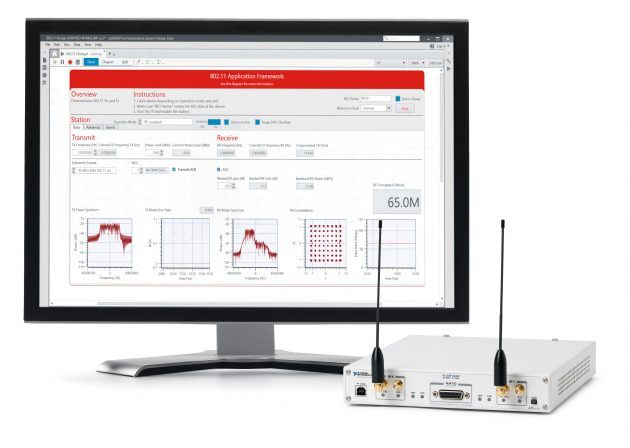
NI the provider of platform-based systems that enable engineers and scientists to solve the world’s greatest engineering challenges announced MAC layer support for its LabVIEW Communications 802.11 Application Framework. Wireless researchers can take advantage of the new multiuser MAC layer enhancements to the 802.11 Application Framework to go beyond the PHY layer to address complex network-level problems that must be solved to make the 5G vision a reality.
5G brings the promise of unseen services and a broad range of use cases such as powering autonomous vehicles, smart factories and eHospitals. While many of these applications will be delivered over cellular links, many will also be served by private networks based on WiFi, which will make 5G a combination of both licensed and unlicensed wireless protocols.



There are many challenges that wireless researchers must address when working toward a more optimal delivery of joint WiFi and 5G cellular services. One is the ability of 5G network slicing to seamlessly deliver end-to-end orchestration across different radio access technologies. Wireless researchers can pair the 802.11 Application Framework with NI software defined radio hardware to rapidly conduct network-level, real-time, over-the-air prototyping experiments for a wide range of WiFi and 5G MAC/PHY research.
The 802.11 Application Framework also supports up to 80 MHz of real-time bandwidth and full bi-directional communications and includes MAC layer features including CSMA/CA, RTS, CTS, NAV, and retransmission. Because the MAC layer is implemented on an FPGA, the 802.11 Application Framework meets the strict timing requirements of the 802.11 specifications to form a complete real-time solution. With these new capabilities, users can take advantage of the 802.11 Application Framework out of the box to conduct a wide range of WiFi experiments and seamlessly integrate custom signal processing algorithms and MAC layer protocols in a fraction of the time compared to other approaches.
As participants in NI’s RF/Communications Lead User program, wireless researchers at Texas A&M University use NI’s flexible prototyping solutions for implementing and validating novel MAC-layer algorithms that can improve performance of WiFi, WiGig and 5G protocol stacks operating in unlicensed spectrum.
“The efficiency of MAC protocols is absolutely critical to the performance of wireless networks,” said P.R. Kumar, IEEE fellow and College of Engineering Chair in Computer Engineering at Texas A&M University. “We have been working on MAC protocols to accommodate the increasingly dense wireless deployments while meeting the system performance demands for the next-generation of wireless networks. However, to have confidence in these protocols, we must implement them on hardware. NI’s 802.11 Application Framework provided us with the tools required to verify the performance of these MAC protocols experimentally under real-world conditions.”
Read this white paper to learn more about the LabVIEW Communications 802.11 Application Framework.

