

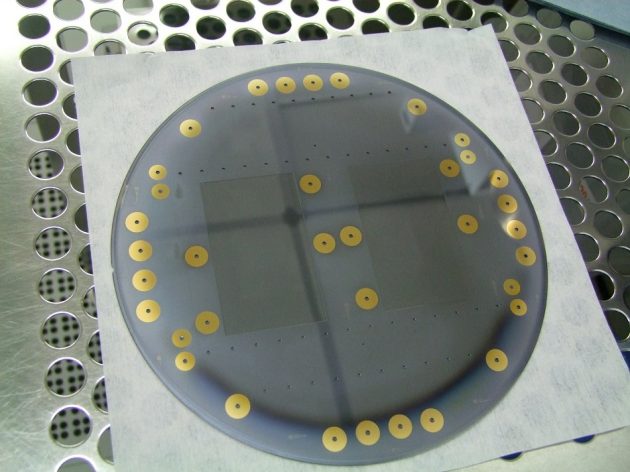
Leti, a research institute of CEA Tech, on Dec. 11, 2017, announced it has created the world’s first microfluidic circuit for cooling a particle detector, perhaps paving the way to a revolutionary, new detector technique at the Large Hadron Collider. This world-first event has been developed for CERN, the European nuclear research organization.




This breakthrough cooling system is part of CERN’s NA62 Gigatracker (GTK), a silicon pixel detector used to measure the arrival time and the position of incoming beam particles in the world’s largest particle accelerator. The NA62 detector is designed to study the “very rare” decay of kaons, subatomic particles made of quarks. Understanding these decays will help physicists check some of the predictions that the Standard Model of particle physics makes about short-distance interactions. Specifically, NA62 will measure the rate at which the charged kaon decays into a charged pion and a neutrino-antineutrino pair.
The Standard Model of particle physics explains how the basic building blocks of matter interact, governed by four fundamental forces in nature: gravity, electromagnetism and the strong and weak nuclear forces.
“The very rare decay of Kaons is sensitive to contributions coming from new particles and therefore represents a powerful way of searching for new physics,” said Augusto Ceccucci, NA62 spokesperson. “This technique complements the direct approach of the LHC detectors, and is a key component in CERN’s programs to probe the ultimate constituents of matter and understand the laws of nature.”
The NA62 is comprised of a set of three innovative silicon pixel detectors, whose job is to measure the arrival time and the position of the incoming beam particles. Installed in the heart of the NA62 detector, the silicon sensors are cooled down to approximately minus-20 degrees Celsius by a microfluidic silicon device developed by Leti and CERN researchers. The cooling system is required to remove the heat produced by the readout chips the silicon sensor is bonded to. The NA62 Gigatracker has a cooling plate on top of which both the silicon sensor and the readout chip are bonded.
In 2012, after CERN chose Leti to supply the microfluidic devices, CERN provided an initial fabrication process-flow that Leti’s Silicon Specialty Solutions (Leti-3S) program implemented in its own flow with its expertise in silicon processing, strictly following CERN’s technical specifications.
Leti-3S scientists demonstrated for the first time in the field of high-energy physics (HEP) the possibility of using silicon microfluidic devices for thermal management of silicon pixel detectors and their read-out electronics in LHC experiments.
Leti’s work included using deep silicon plasma-etching processes for microchannel production, its expertise at bonding silicon wafers at microscopic levels, and further grinding and thinning. In addition, Leti built titanium-nickel-gold contacts to connect the coolers to the NA62 device.
“The challenge was above all that we had only two pieces per wafers because of their large dimensions, meaning that two defects could result in a zero-percent yield,” said Catherine Charrier, project leader at Leti. “Maintaining the quality of the coolers on the centimeter dimensions, while respecting micrometric specifications, was a real challenge that we were able to overcome.”
Since being selected by CERN to work on NA62, Leti has contributed to the development of several types of cooling devices.
“Producing these silicon coolers provides us the opportunity to contribute to the scientific communities that use large instruments, which will expand Leti’s scope of operation,” Charrier said.
For more information, visit www.leti-cea.com

