
Maxim Integrated Products, Inc., a leader in high-performance analog integration, has collaborated with NVIDIA to support the industry’s first Level 5 full-autonomy system, the NVIDIA DRIVE Pegasus platform, as well as NVIDIA DRIVE Xavier for Level 4 driving.
Maxim’s Automotive Safety Integrity Level (ASIL) solutions and high-performance analog integration, which include next-generation gigabit multimedia serial link (GMSL) serializer and deserializer (SerDes) technology, as well as a power system monitoring solution, provide the flexible foundation necessary to meet functional safety requirements for NVIDIA’s autonomous driving platform.




To address consumer concerns about driver safety in autonomous vehicles, automakers have increased their focus on safety requirements for ADAS applications. Safety-critical systems, which require redundancy and fault diagnostics, have stringent ASIL requirements. These ADAS systems need interconnect technology that enables the data-rich environment for the car of the future. Maxim’s ASIL rated voltage/power monitoring and SerDes technology will be used by NVIDIA to achieve the industry’s first Level 5 autonomous driving system needed to make self-driving cars a reality.
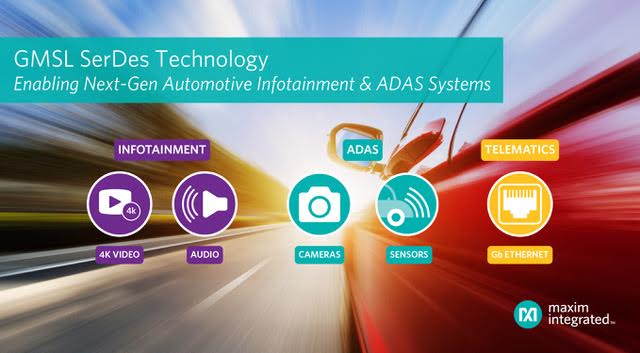
Maxim’s next-generation 6Gbps GMSL SerDes technology supports the high data rate, complex interconnect, and data integrity requirements of future automotive infotainment, ADAS, and autonomous driving. This technology also provides the safety-relevant features and flexibility needed to build autonomous driving systems such as the DRIVE Pegasus and DRIVE Xavier platforms. As part of the high-performance analog integrations, Maxim also supplies low IQ automotive-grade power management solutions.
Commentary
- “Maxim’s new generation of GMSL SerDes technology, analog integration capability, and a strong commitment to the automotive market is the right combination to drive NVIDIA’s supercomputer platform to the finish line,” said Randall Wollschlager, Vice President of Automotive at Maxim Integrated.
- “The NVIDIA DRIVE AI platform, which is scalable from Super Level 2 to the fully autonomous capabilities of Level 5, requires high bandwidth camera data transmission and aggregation,” said Gary Hicok, Senior Vice President of Hardware Development at NVIDIA. “Working with Maxim’s safety solutions, NVIDIA is delivering the highest functional safety standards that the industry demands.”
Learn more at https://www.maximintegrated.com.

