
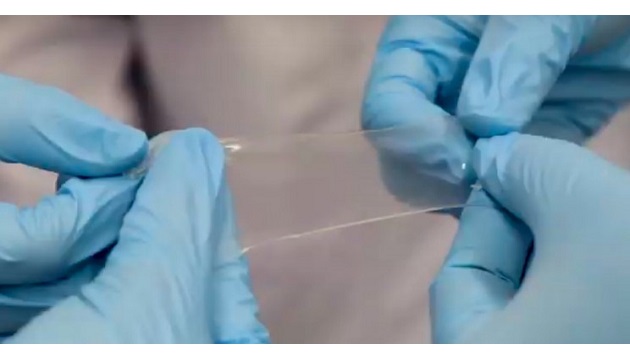
A team of researchers at the National University of Singapore (NUS), inspired by Jellyfish, have discovered an electronic skin with a similar functionality. The electronic skin is transparent, touch-sensitive, stretchable, and have an ability to repair itself in both, wet and dry conditions, even in air or when submerged in water.
There are wide ranging uses for the novel material, from water-resistant touch screens to aquatic soft robots aimed at mimicking biological tissues.




The innovation has been developed by Assistant Professor Benjamin Tee and his team from the Department of Materials Science and Engineering, along with collaborators from Tsinghua University and the University of California Riverside.
Commenting on the experience in this research area, Tee said, “One of the challenges with many self-healing materials today is that they are not transparent and they do not work efficiently when wet. These drawbacks make them less useful for electronic applications such as touchscreens which often need to be used in wet weather conditions.”
He continued, “With this idea in mind, we began to look at jellyfishes, they are transparent, and able to sense the wet environment. So, we wondered how we could make an artificial material that could mimic the water-resistant nature of jellyfishes and yet also be touch sensitive.”
The Electronic skin project has been succeeded by creating a gel consisting of a fluorocarbon-based polymer with a fluorine-rich ionic liquid. The self-healing property in this material is achieved, by the combination of the polymer network with the ionic liquid via highly reversible ion-dipole interactions.
Next Generation Soft robots
The electronic skin is created by printing the novel material into electronic circuits. As a soft and stretchable material, its electrical properties change when being touched, pressed or strained.
Soft robots, and soft electronics in general, aim to mimic biological tissues to make them more mechanically compliant for human-machine interactions. In addition to conventional soft robot applications, this novel material’s waterproof technology enables the design of amphibious robots and water-resistant electronics.
One further advantage of this self-healing electronic skin is the potential it has to reduce waste. Assistant Professor Tee explained, “Millions of tonnes of electronic waste from broken mobile phones, tablets, etc. are generated globally every year. We are hoping to create a future where electronic devices made from intelligent materials can perform self-repair functions to reduce the amount of electronic waste in the world.”

