
Description
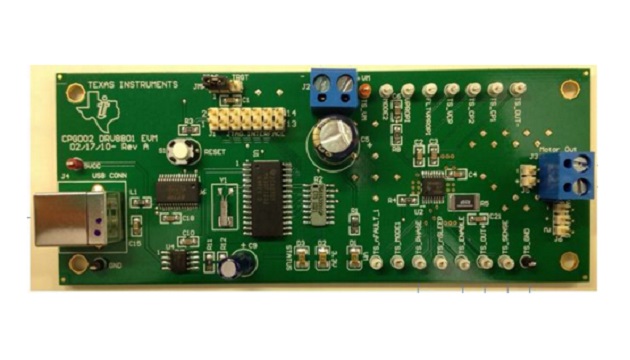
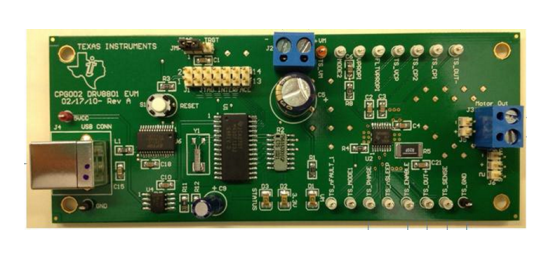
This TI Design features the DRV8801EVM and the DRV8872EVM. These evaluation modules (EVMs) enable an easy-to-use platform to demonstrate the capability and performance of the DRV8801 and DRV8872 motor drivers for power-folding side mirrors. This TI Design also intends to allow easy evaluation of the automotive qualified versions of the DRV8801 and DRV8872 (DRV8801-Q1 and DRV8872-Q1). The DRV8801-Q1 is a 2.8-A peak, full-bridge, brushed DC motor driver capable of driving the retracting function of vehicle side view mirrors.




With the built-in automotive protection features of overcurrent, thermal, shoot-through, UVLO, and wide-input voltage (wide VIN) range, this motor driver provides the necessary features to survive a harsh automotive environment. Additionally, this TI Design provides test data to allow the designer to quickly evaluate the performance of the DRV8801-Q1 and the DRV8872-Q1 for their folding-mirror modules.
 Features:
- Single H-Bridge Motor Driver With Integrated Protection Features of Overcurrent, Thermal, and Undervoltage Lockout for Higher System Reliability Overvoltage Protection: 45 V
- Wide 8-V to 36-V Input Supply Range Easily Supports +12-V and +24-V Industry Standard Supplies
- High 2.8-A Peak Current Helps Support Large Startup and Stall Inrush Currents
- EVM includes easy to use GUI
- Phase and Enable Control Interface Provides Simple, 2-pin Control Interface for Motor Operation
- Brake Mode Support Allows the Motor to Stop Quickly
- Available AEC-Q100 Device Options for EVM ICs
Applications:
- Automotive Body and Convenience Electronics
- Car Side-View Mirrors
- Grill Shutters
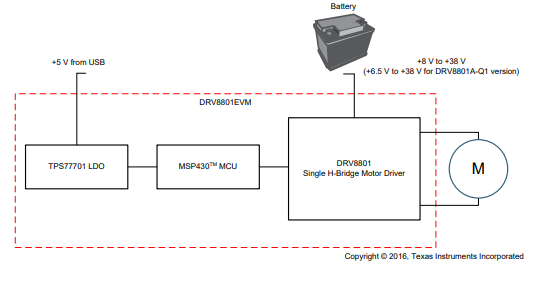
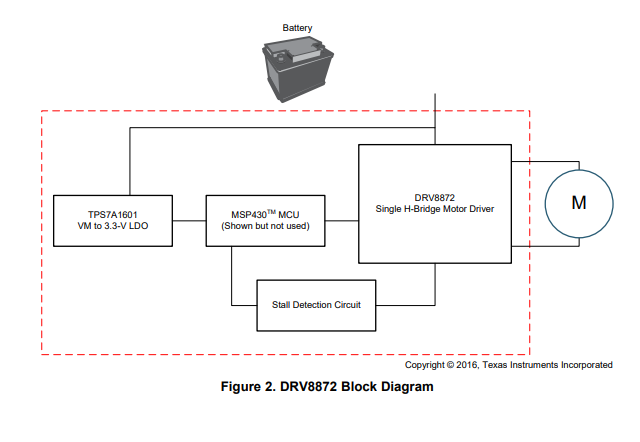
 1.1 Block Diagram
Figure 1 shows the DRV8801 block diagram, and Figure shows the DRV8872 block diagram.

 1.2 DRV8801EVM Quick Start Guide
Use the following instructions for test setup.
- Install the EVM graphics user interface (GUI), then connect the PC to the DRV8801EVM using USB CONN (J4).
- Connect the 12-V power supply and ground to the DRV8801EVM through +VM and –VM, respectively
(J2).
- Connect the motor leads to the DRV8801EVM through Motor Out (J3).
- Connect the TS_PHASE and TS_ENABLE pins to the 3.3-V power supplies.
The firmware and GUI (as is) only support pulse width modulation (PWM) control, so connecting the pins to a logic supply can simplify the testing to provide 100% duty cycle signals.
- Connect the scope leads to the DRV8801EVM at TS_OUT+ and TS_OUT–.
- Connect the scope and current probe to the DRV8801 through TS_SENSE.
1.3 DRV8872EVM Quick Start Guide
Use the following instructions for test setup.
- Create a stall detection circuit (see TIDR549).
- Connect the 12-V power supply and ground to the DRV8872EVM through VM and GND, respectively.
- Connect the motor leads to the DRV8872EVM through OUT1 and OUT2.
- Connect the scope leads to the DRV8872EVM at OUT1, OUT2, and nSTALL.
- Connect the scope and current probe to the DRV8872 through OUT1.
- Control the forward or reverse direction by connecting IN1 or IN2 to V5P0.
1.4 Design Considerations
Linear Regulator: The EVM uses the TPS77071 LDO to power the MCU, but the designer may also consider the TPS7A66xx and TPS7A69xx LDOs from TI’s automotive high-voltage LDO portfolio. LDOs in the TPS7A66xx and TPS7A69xx part families feature a low 12-µA quiescent current and short-circuit and overcurrent protection.
MCU: The motor operation through the motor driver interface of the 2-pin control is managed by the onboard MSP430. TI has automotive qualified MSP320 devices, and TI recommends the MSP320F2272-Q1 for this design.
Motor: Because most motor-driven automotive convenience features do not require highly efficient motors and cost is typically more of a concern, a brushed motor was selected for the wing-mirror folding function.
Motor Driver, DRV8801: The DRV8801 is a single H-bridge, integrated motor driver with protection features and can handle the necessary current to fold a mirror. Also, while the DRV8801 onboard the EVM is not automotive qualified, TI has an automotive qualified version (DRV8801-Q1) available. The automotive version supports the same features and functionality.
Motor Driver, DRV8872: The DRV8872 is a single H-bridge, integrated motor driver with protection features and can handle the necessary current to fold a mirror. Also, while the DRV8872 onboard the EVM is not automotive qualified, TI has an automotive qualified version (DRV8872-Q1) available. The automotive version supports the same features and functionality.
Article Courtesy: Texas Instruments

