
Courtesy: Renesas
With automation and IoT part of our daily lives, advanced security is even more important in low-power devices to keep buildings secure, deter intruders from homes, and protect users from any data modification or leakage.




The RA4L1 MCU is designed to bring more security to low-power devices. Implemented on Renesas’ advanced low-power process technology, RA4L1 supports low-voltage operation down to as little as 1.6V while offering low standby current down to 1.65µA with 16kBytes of SRAM retained. The 80MHz Arm Cortex-M33 core with Floating Point Unit (FPU) and TrustZone includes features such as segment LCD and an advanced security engine to support a wide range of low-power systems that need to secure their application and communications.
RA4L1 offers 512kBytes of on-chip dual bank flash with block swap functionality, allowing the easy implementation of applications that can be updated in the field, as well as 8kBytes of dataflash allowing the replacement of external EEPROMs for data storage. Most importantly, RA4L1 has 64kBytes of on-chip SRAM with both parity and ECC support for applications concerned about data integrity and safety.
The group offers seven different packages, including LQFP, QFP, BGA, and CSP options measuring only 3.64mm x 4.28mm on CSP. These package options make the RA4L1 attractive for many applications where space is at a premium.
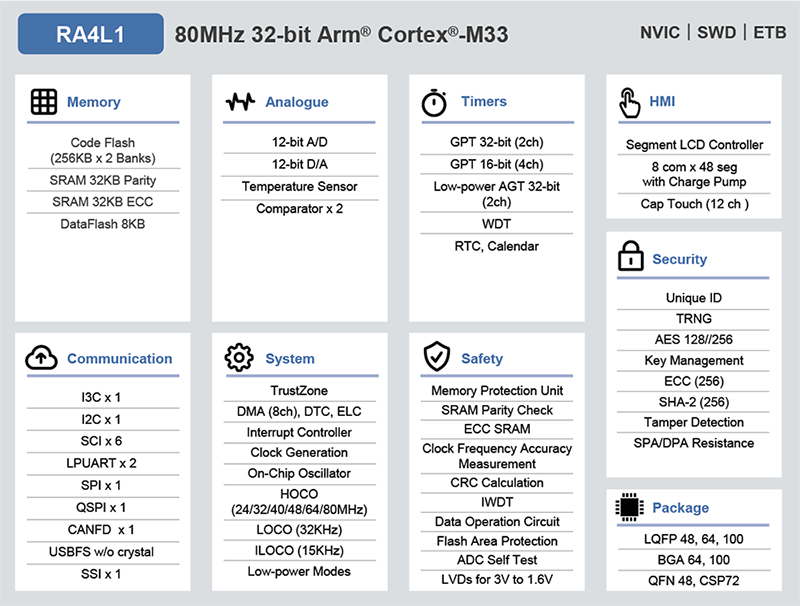
The RA4L1 supports a wide range of peripheral features that have been optimized for low-power applications with a wide range of communication interfaces, along with a wealth of analog and system features.
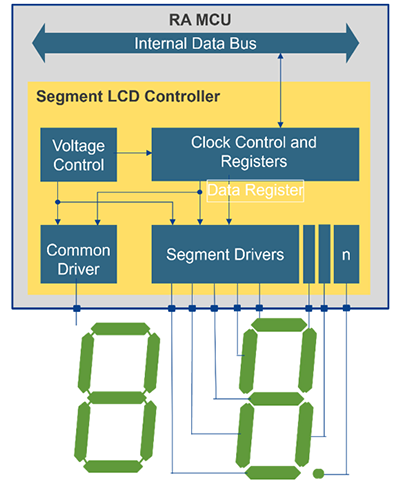
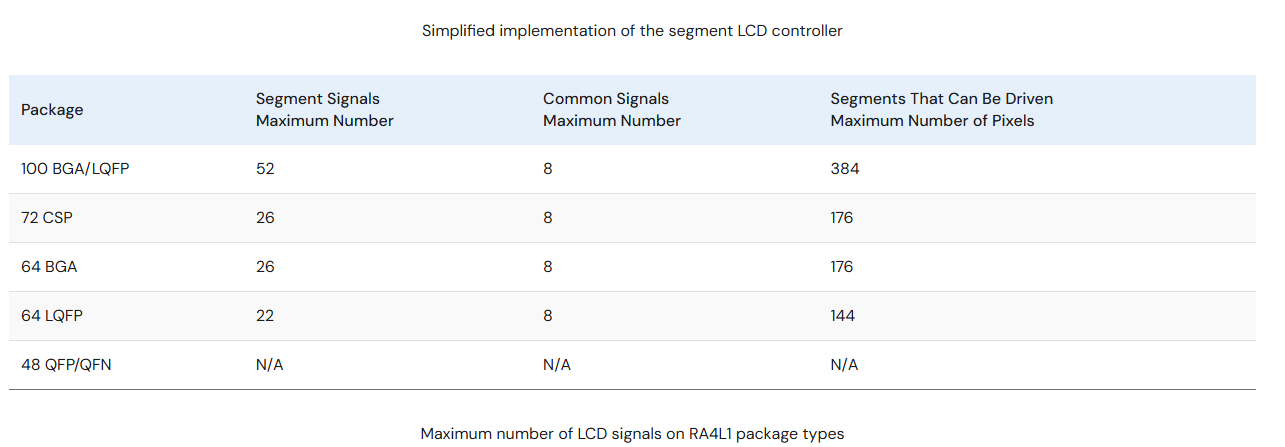
One of the key features of the RA4L1, often required in low-power applications such as smart meters and smart thermostats, is the segment LCD controller. It is designed to operate in the lowest power modes of the RA4L1 while being capable of driving a segment LCD with up to 384 segments.
Below is a simplified block diagram of the segment LCD controller and a table showing the available number of segments in each package.
With new cybersecurity regulations and the growing importance of security in general, to protect data and secure communications, every application will need to consider security more carefully in the future, and the Robust Security IP (RSIP) is designed to help you do just that. RA4L1 implements a wide range of advanced security functions, including:
- RSIP-E11A security engine
- Key wrapping
- Secure key injection and update
- Device Lifecycle Management (DLM) states
- Authentication and protection levels
- Secure factory programming
- Arm TrustZone
- Tamper detection
- Lockable flash
At the heart of the RA4L1 security capabilities is the RSIP security engine, an isolated subsystem within the MCU. The security engine is protected by an access management circuit, which shuts down the crypto engine in the event of an illegal external access attempt, protecting against attacks such as differential fault analysis. The crypto engine contains hardware accelerators for both symmetric and asymmetric cryptographic algorithms, as well as various hashes and message authentication codes. Within the security engine is a component of the MCU hardware root key, used for storing and injecting other keys, as we shall see later. It also contains a true random number generator with an SP800-90B-compliant entropy source and an NIST-certified DRBG algorithm.
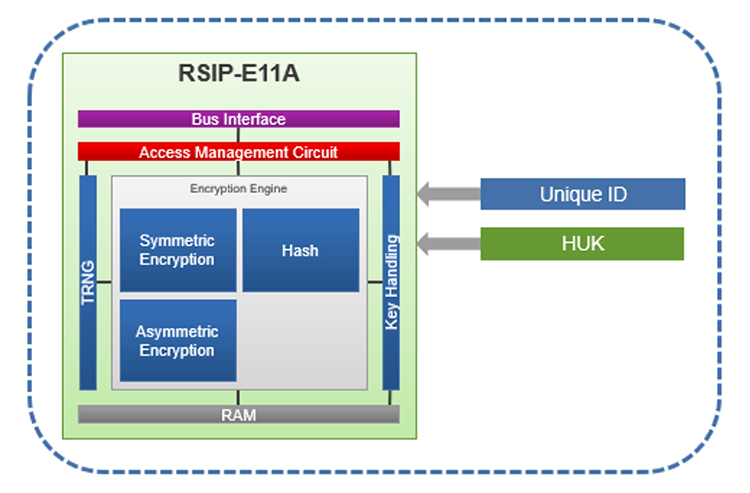
The security engine contains internal RAM for operations that deal with sensitive material ,such as plain text keys. This RAM is not accessible outside the security engine. The RSIP security engine can be combined with higher-level security constructs in the Renesas Flexible Software Package (FSP). FSP is an enhanced software package designed to deliver user-friendly, scalable, high-quality software for embedded system designs using any RA Arm microcontrollers, ensuring software compatibility across the entire family. The embedded drivers and security primitives implemented in the FSP provide a complete solution for embedded data protection and identity.
These functions make the RA4L1 ideal for a wide range of applications where low-power operation, multiple communications functions, LCD drive, and especially security features are required, including:
- Audio systems
- Access control systems
- Consumer products
- Industrial and utility metering applications
- Security systems
- Smart locks
- Industrial sensors
Conclusion
As low-power devices continue to take on more connected and autonomous roles, security can no longer be treated as an add-on—it must be embedded at the silicon level. Renesas’ RA4L1 MCU demonstrates how advanced security, ultra-low-power operation, and rich peripheral integration can coexist in a compact, cost-effective design. With its Robust Security IP, Arm TrustZone support, secure lifecycle management, and strong cryptographic foundations, the RA4L1 addresses both today’s regulatory demands and tomorrow’s threat landscape. For designers building secure, always-on systems such as smart meters, access control, and connected consumer devices, the RA4L1 offers a compelling platform that safeguards data and communications without compromising power efficiency or design flexibility.

