

Courtesy: Renesas
The demand for real-time data processing and decision-making is growing across industries such as robotics, autonomous vehicles, and smart cities. Traditional cloud-based AI processing introduces latency and requires constant internet connectivity, which can be impractical or inefficient for many applications. How can industries overcome these challenges to leverage AI effectively at the edge? Renesas Electronics has been addressing this market need by developing the RZ/V series of embedded AI processors since 2019. These processors are designed to process data locally, right where it is collected, instead of relying on cloud servers. This approach reduces latency, lowers power consumption, and enhances operational efficiency.




One of the primary challenges in edge AI is managing power consumption without compromising performance. The RZ/V2H features Renesas’ proprietary DRP-AI3, an AI accelerator that delivers AI performance comparable to other embedded GPUs but at just one-third of the power consumption. This is a game-changer for battery-powered or energy-sensitive applications, such as drones or remote sensors, where power efficiency is crucial. To handle complex AI tasks efficiently, the RZ/V2H is equipped with a 1.8GHz quad-core 64-bit processor. This robust processing power ensures that the device can manage demanding AI workloads seamlessly. In addition to the primary processor, the RZ/V2H includes a dual-core Arm® Cortex®-R8 RTOS processor operating at 800MHz. This secondary processor is optimized for high-speed operations and real-time tasks, ensuring that the AI accelerator’s recognition and judgment outputs can be applied immediately to control mechanisms. This feature is particularly beneficial for next-generation robotics, where real-time decision-making is critical.
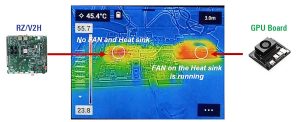
Figure 1 illustrates the heat generated by the RZ/V2H and a GPU board when the same AI process is executed, as captured by an infrared camera. Unlike GPUs, which typically require cooling fans due to their high power consumption, RZ/V2H maintains a similar temperature without the need for any cooling mechanisms.
This low power consumption is perfect for autonomous robots and drones, where battery capacity is limited. It is also ideal for compact endpoint AI devices, where adding cooling mechanisms is challenging due to the small chassis size.
The RZ/V2H, paired with Renesas’ RAA215300 high-performance 9-channel power management IC and the VersaClock 3S programmable clock generator, provides a comprehensive solution for developing autonomous robots, Automated Guided Vehicles (AGVs), robot cleaners, and other applications requiring high AI performance and low power consumption. Our High-Performance Vision AI System Winning Combination offers a streamlined, all-in-one package for these advanced AI applications.

