

Developing methods to accurately reconstruct spatial fields using data collected by sparse sensors has been a long-standing challenge in both physics and computer science. Ultimately, such methods could significantly aid the design, prediction, analysis and control of complex physical systems.
So far, traditional methods based on linear theory achieved poor performances when reconstructing global fields for complex physical systems or processes, particularly when only a limited amount of sensor data is available or when sensors are randomly positioned. In recent years, computer scientists have thus been exploring the potential of alternative methods for global field reconstruction, including deep learning models.




Researchers at Keio University in Japan, University of California- Los Angeles and other institutes in the U.S. have recently developed a new deep learning tool that can accurately reconstruct global fields without the need for extensive and highly organized sensor data. This method could open new interesting possibilities for several areas of research, including geophysics, astrophysics and atmospheric science.
“Achieving accurate and robust global situational awareness of a complex time-evolving field from a limited number of sensors has been a long-standing challenge,” Kai Fukami and his colleagues wrote in their paper. “This reconstruction problem is especially difficult when sensors are sparsely positioned in a seemingly random or unorganized manner, which is often encountered in a range of scientific and engineering problems.”
When studying atmospheric phenomena, astrophysical processes and other complex physical systems, researchers often only have access to data collected by a limited number of sensors positioned in unorganized ways. In some instances, these sensors can also be moving and may go offline for some periods of time.
This lack of ideal sensor data has so far made it difficult to reconstruct global fields for these complex systems. While deep learning techniques have achieved some promising results, implementing them can often be highly expensive and computationally demanding.
The global field reconstruction technique developed by Fukami and his colleagues merges deep learning with Voronoi tessellation, a way of representing and describing biological structures or physical systems. In the past, Voronoi tessellations or diagrams have been used in many areas of science and engineering.
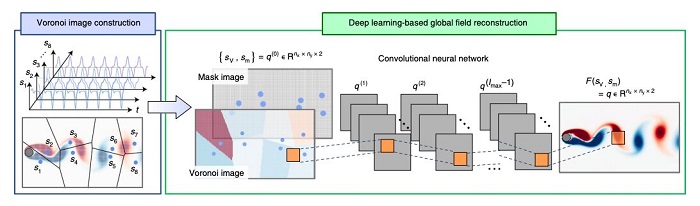
“We propose a data-driven spatial field recovery technique founded on a structured grid-based deep-learning approach for arbitrary positioned sensors of any numbers,” Kai Fukami and his colleagues explained in their paper. “We consider the use of Voronoi tessellation to obtain a structured-grid representation from sensor locations, enabling the computationally tractable use of convolutional neural networks (CNNs).”
The technique created by the researchers incorporates the data collected by sparse sensors into a CNN, approximating local information onto a structured representation, while retaining data related to the location of sensors. To do this, it constructs a Voronoi tessellation of the unstructured dataset and then adds the input data field corresponding to the location of the sensors, implementing it as a mask.
Two advantageous features of this method for global field reconstruction are that it is compatible with deep learning-based techniques that have proved promising for advanced image processing and it can also be implemented with an arbitrary number of sensors. So far, the researchers demonstrated the effectiveness of their approach by using it to reconstruct global fields using three different sets of sensor data, namely unsteady wake flow, geophysical data and 3D turbulence data.
In contrast with previously proposed methods, the tool developed by Fukami and his colleagues also works with data collected by a random number of moving sensors. In the future, it could thus have many valuable applications, enabling global field estimation for different physical systems in real-time, even in instances where sensors are positioned in unorganized ways.

