
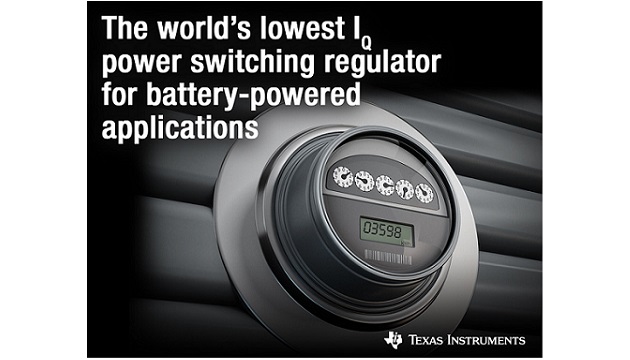
Texas Instruments (TI) introduced an ultra-low-power switching regulator with the industry’s lowest operating quiescent current (IQ) at 60 nA – 1/3 that of the nearest competitive device. The TPS62840 synchronous step-down converter delivers very high light-load efficiency of 80% at 1-µA load, which can enable designers to extend the battery life of their systems, or use fewer or smaller batteries to shrink their overall power supply solution size and reduce cost. Additionally, the new DC/DC converter’s wide input voltage (VIN) range of 1.8 V to 6.5 V supports a variety of battery chemistries and configurations.
These features plus its selectable functions enable the TPS62840 to help engineers solve critical design challenges in many battery-powered, always-on industrial and personal electronics applications, including narrow-band Internet of Things (IoT), grid infrastructure equipment and wearables, that require more flexibility, an extended wireless range, improved accuracy and reduced electromagnetic interference (EMI).




The TPS62840 joins TI’s portfolio of highly integrated, low-IQ DC/DC converters that enable designers to maximize power delivery in the smallest possible solution size.
Key features and benefits of the TPS62840:
- Longer battery life, very high light-load efficiency: A lower IQdraw delivers longer battery life for systems with very light loads (less than 100µA), and those operating primarily in standby/ship mode (not switching). The low IQ of the TPS62840 enables its 80% efficiency at a 1-µA load, which is up to 30% better than competitive devices.
- Selectable modes enhance performance, lower overall cost: The TPS62840’s selectable mode and stop functions improve noise performance and reduce signal distortion. These benefits can help lower the solution cost because designers can achieve system requirements without using more expensive precision signal-chain components, sensors or radio solutions to perform the same functions.
- The mode pin allows for continuous conduction mode, also called forced pulse-width modulation mode, to improve ripple or noise performance and lessen the impact on transmissions in sensitive radio-frequency applications.
- The stop pin turns off all switching to reduce EMI or ripple, and minimizes distortions passed to precision signal-chain, measurement, sensors or wireless connectivity components.
- Smaller solution size: Engineers can use the new switching regulator to cut their battery count in half or use smaller batteries in their design. For example, designers can save up to 16,980 mm3using four AAAs instead of four AAs.
- Flexible VINbroadens applications: The TPS62840’s wide range of 1.8 VIN-6.5 VIN accommodates multiple battery chemistries and configurations, such as two lithium manganese dioxide (2s-LiMnO2) cells in series, single-cell lithium thionyl chloride (1xLiSOCL2), four-cell and two-cell alkaline, and lithium polymer (Li-Po).
For more information, visit: www.ti.com

