

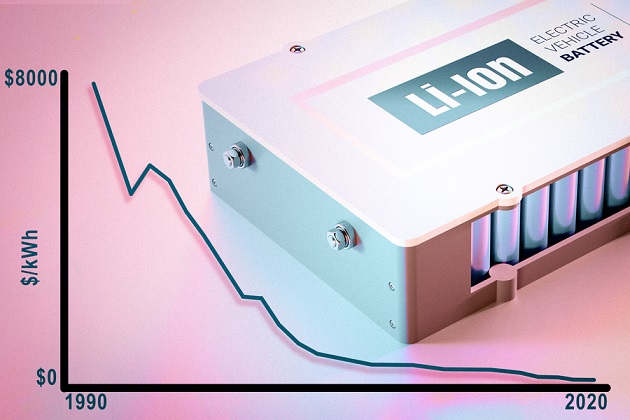
The cost of the rechargeable Lithium-Ion Battery used for phones, laptops, and cars has fallen dramatically over the last three decades and has been a major driver of the rapid growth of those technologies. But attempting to quantify that cost decline has produced ambiguous and conflicting results that have hampered attempts to project the technology’s future or devise useful policies and research priorities.
The researchers found that the cost of these batteries has dropped by 97 per cent since they were first commercially introduced in 1991. This rate of improvement is much faster than many analysts had claimed and is comparable to that of solar photovoltaic panels, which some had considered to be an exceptional case.



Most lithium-ion batteries are not sold directly to consumers — you can’t run down to your typical corner drugstore to pick up a replacement battery for your iPhone, your PC, or your electric car. Instead, manufacturers buy lithium-ion batteries and build them into electronics and cars. Large companies like Apple or Tesla buy batteries by the millions, or manufacture them themselves, for prices that are negotiated or internally accounted for but never publicly disclosed.
The new findings are not just a matter of retracing the history of battery development, but of helping to guide the future. Combing all of the published literature on the subject of the cost reductions in lithium-ion cells, he found “very different measures of the historical improvement. And across a variety of different papers, researchers were using these trends to make suggestions about how to further reduce costs of lithium-ion technologies or when they might meet cost targets.
Lithium-ion batteries were not adopted because they were the least expensive technology at the time. There were less expensive battery technologies available. Lithium-ion technology was adopted because it allows you to put portable electronics into your hand because it allows you to make power tools that last longer and have more power, and it allows us to build cars” that can provide an adequate driving range. It felt like just looking at dollars per kilowatt-hour was only telling part of the story.

