

Information can be imprinted on single photons that can in turn, perform calculations and transmit messages. Creating the “individual” photon to do that is a complicated and challenging process though.
With the help of fiber optics and fast optical switches, researchers at the University of Bath’s Center for Photonics and Photonic Materials have developed a new way to improve the performance of single-photon sources.



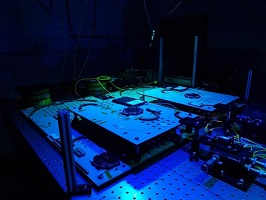
Consisting of two all-fiber individual photon pair sources, each mounted on one of the wooden platforms to provide long term stability and protection. Each source is made entirely from various types of optical fiber, much of which has been fabricated at the University of Bath. Courtesy of University of Bath, Center for Photonics and Photonic Materials.
They combined several individual sources of photons using optical switches — a technique called multiplexing — using fiber optics fabricated at the University. The new device makes generating single photons more reliable and allows control of the photons properties.
 Robert Francis-Jones, from the Center for Photonics and Photonic Materials, said “Developing improved sources of single photons is one of the most pressing issues in quantum information processing. Through this research we hope to accelerate the transition of quantum-enhanced technologies from the lab to applications such as drug discovery.”
The air hole cladding of the fiber is produced by stacking one meter long glass capillaries in a hexagonal pattern. This preform, called a “stack” that is around 25 mm in diameter when finished, will be placed inside a large glass tube, heated in a furnace and reduced in size in a series of stages to around a final diameter of 125 um to produce the final fiber. Courtesy of University of Bath, Center for Photonics and Photonic Materials.
 The invention will benefit a variety of processes which rely on photons to carry quantum information, such as quantum computing, secure quantum communication and precision measurements at low light levels.
The research was funded by the Engineering and Physical Sciences Research Council (EPSRC), and is published in the journal Optica.

