
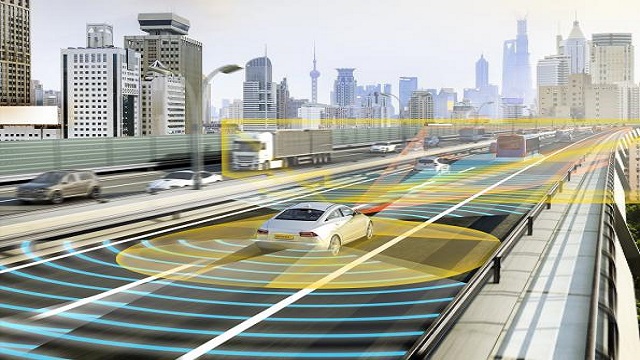
The AURIX microcontroller family from Infineon Technologies AG helps realize automated driving: It is used as a critical safety compute element and vehicle interface for the NVIDIA DRIVE PX 2 AI car computing platform.
NVIDIA autonomous vehicle computing platforms are integrated in various advanced driver-assistance systems (ADAS) of newly produced vehicles and initial Level 3 autonomous driving cars to reach production. The AURIX multicore microcontrollers feature advanced hardware capabilities for functional safety. They are integrated into the platform as safety controllers for ADAS and autonomous driving (AD) systems now deployed worldwide.




At its OktoberTech 2017 Technology Forum Infineon will demonstrate the latest technologies underlying autonomous and electric driving including sensors, microcontrollers and power semiconductor solutions.
AURIX microcontrollers power automated driving
AURIX multicore microcontrollers help the NVIDIA DRIVE PX platform meet the highest possible functional safety standard (ISO 26262 ASIL-D) for self-driving systems. Key features of the AURIX microcontrollers relevant to bringing ADAS and AD to the street include lock-step cores, redundant peripherals, integrated monitoring systems and up to 1,800 DMIPS of real-time performance based on the TriCore multicore architecture of Infineon.
Today’s AURIX TC2xx family provides critical functionality including power-up sequence management and monitoring of warning signals for the self-driving platform. The AURIX microcontrollers also act as the decision maker or “voter” for specific tasks that must comply with ASIL-D safety standards and as the main in-vehicle interface for multiple network communication channels such as CAN, Ethernet, FlexRay and LIN.
The collaboration of Infineon and NVIDIA enables users of the DRIVE PX platform to access the AURIX capabilities through an AUTOSAR-compliant software stack. Thus, higher-level application layers can easily be adapted, thereby reducing development time by 20 percent to 40 percent compared to traditional platforms.
“Infineon makes autonomous driving safe and reliable, and the collaboration with NVIDIA is a great example of one such important initiative,” said Ritesh Tyagi, Head of the Silicon Valley Automotive Innovation Center (SVIC) at Infineon Technologies. “To support this effort, Infineon has established the Innovation Center in Silicon Valley to work closely with technology partners and mobility disruptor customers including traditional car manufacturers and their system suppliers.”
Infineon is now expanding the AURIX family with its next generation, the TC3xx family. It will offer higher integration, and real-time performance that is three times higher than what is available today. This allows system suppliers to easily migrate to the TC3xx family by leveraging the development investment in the AURIX TC2xx family.
The AURIX multicore microcontroller families will fuel autonomous driving applications in the coming years. AURIX TC2xx and TC3xx microcontrollers are expected to be widely deployed in various data fusion architectures worldwide.
For more information on AURIX microcontrollers and the automotive product portfolio visit www.infineon.com/aurix and www.infineon.com/automotive

