
HomeNewsIndia NewsLithium-ion batteries made safe with fireproof, lightweight solid electrolyte

    Lithium-ion batteries made safe with fireproof, lightweight solid electrolyte

    Lithium-ion batteries are in everything from cell phones to cars. However, recent incidents involving fires or explosions of these devices show there’s a need for safer batteries. One option is to replace the flammable liquid electrolyte with a solid-state electrolyte (SSE). But some of the most-studied SSEs are themselves flammable, leaving the original safety concern unaddressed. Researchers now report in ACS’ Nano Letters that they have developed an SSE that won’t burn up.

    Traditional lithium-ion batteries consist of a cathode and anode, separated by a liquid electrolyte and a thin piece of porous plastic. If the battery is damaged — for example, if it is overcharged or if needlelike lithium projections grow and pierce the plastic separator — the electrolyte can catch fire. Scientists have experimented with a variety of solutions, such as adding fire retardants to the electrolyte, or replacing the soft and flammable separator and electrolyte with an SSE. However, state-of-the-art SSEs have their own limitations, including brittleness and heaviness. Fragility can be reduced by using a polymer SSE, but lithium needles can still breach these soft materials. Polymer/ceramic composite SSEs get around that problem, but most of these materials are still flammable. Yi Cui and colleagues wanted to design a safer alternative.

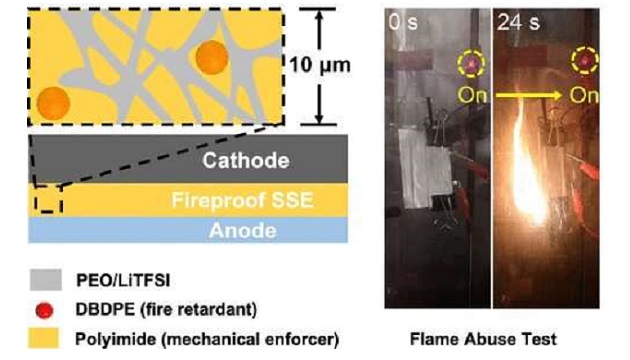
    The team developed an SSE composed of a porous mechanical support (a polyimide film), fire-retardant additive (decabromodiphenyl ethane), and polymer electrolyte (polyethylene oxide/lithium bis[trifluoromethanesulfonyl]imide). The researchers say this is the first ultralightweight polymer-based SSE that is fireproof. In fact, a battery they made from this SSE continued to function well even when it was exposed to flames. In addition, the new SSE can provide an energy density and performance at least comparable to conventional lithium-ion batteries.

    ELE Times Research Desk
    ELE Times Research Deskhttps://www.eletimes.ai
    ELE Times provides a comprehensive global coverage of Electronics, Technology and the Market. In addition to providing in depth articles, ELE Times attracts the industry’s largest, qualified and highly engaged audiences, who appreciate our timely, relevant content and popular formats. ELE Times helps you build awareness, drive traffic, communicate your offerings to right audience, generate leads and sell your products better.

    LEAVE A REPLY

    Please enter your comment!
    Please enter your name here

    Related News

    Must Read

    How AI Is Powering the Road to Level 4 Autonomous Driving

    Courtesy: Nvidia When the Society of Automotive Engineers established its...

    Revolutionizing System Design with AI-Powered Real-Time Simulation

    Courtesy: Cadence The rising demand for AI infrastructure is driving...

    Microchip Technology Expands its India Footprint with a New Office Facility in Bengaluru

    Microchip Technology has expanded its India footprint with the...

    How Quantum Sensors and Post-Moore Measurement Tech Are Rewriting Reality

    When the chip industry stopped promising effortless doublings every...

    Rohde & Schwarz Mobile Test Summit 2025 on the future of wireless communications

    Rohde & Schwarz has announced that this year’s Mobile...

    Infineon and SolarEdge collaborate to advance high-efficiency power infrastructure for AI data centres

    Infineon and SolarEdge are partnering to advance the development...

    Evolving Priorities in Design Process of Electronic Devices

    One of the natal and most crucial stages of...

    New Radiation-Tolerant, High-Reliability Communication Interface Solution for Space Applications

    Microchip Technology announced the release of its Radiation-Tolerant (RT) ATA6571RT...

