
Mouser Electronics, Inc., announces a new global distribution agreement with Advanced Photonix, a division of OSI Optoelectronics. Advanced Photonix is the leading global provider of innovative photonics, optoelectronics, and advanced electronic systems for leading aerospace and defense, medical, and industrial OEMs that demand high-reliability, high-performance technology today. Mouser now stocks the company’s advanced silicon, InGaAs P-I-N, APD photodiodes and hybrids, and CdS LDR photocells through the agreement.
Advanced Photonix designs, develops, and fabricates complex photodetectors, emitters and photoresistors. With state-of-the-art, in-house semiconductor fabrication services, Advanced Photonix leads the industry in providing the best and most reliable optoelectronics components and subsystems. With more than 30 years of experience in the field of optoelectronics, Advanced Photonix has the expertise to develop efficient manufacturing processes that exceed the rigorous standards set by industrial, medical, and defense applications.




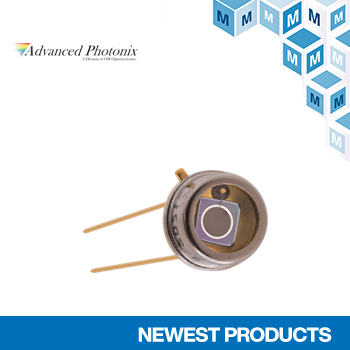
The Advanced Photonix UV enhanced silicon photodiode offers a high-performance, cost-effective solution for applications requiring highly sensitive devices in the UV region. The device features low noise, high shunt resistance, and increased response with an active area diameter of 2.54 mm. Red enhanced P-I-N and quadrant silicon photodiodes are available in various features and packages for a wide range of applications. The devices feature high accuracy with a large active area and low crosstalk, ideal for accurate nulling, centering, or measuring small positional changes. The Blue enhanced P-I-N photodiodes offer high responsivity, large active area, and low noise. The devices are ideal for high-speed response applications in the blue region of the electromagnetic spectrum.
Advanced Photonix CdS photocells are light-dependent resistors (LDRs) with sensitivity in the visible light region from 400 nm to 700 nm. The LDRs, available in a wide range of resistances, decrease resistance as the light level increases with efficiency characteristics like those of the human eye.
For more information, visit www.mouser.com/manufacturer

