
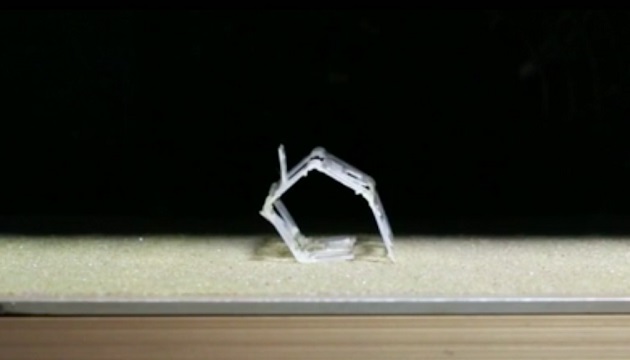
In the world of robotics, the soft robots completely rely on the external power and control, keeping them tethered to off-board systems or rigged with hard components. A new soft robotic system, inspired by origami has been developed by the researchers of Harvard John A. Paulson School of Engineering and Applied Sciences (SEAS) and Caltech. The robot can move and change shape in response to external stimuli, paving the way for fully untethered soft robots.
“The ability to integrate active materials within 3D-printed objects enables the design and fabrication of entirely new classes of soft robotic matter,” said Jennifer A. Lewis, the Hansjorg Wyss Professor of Biologically Inspired Engineering at SEAS and co-lead author of the study.




The researchers turned to origami to create multifunctional soft robots. Through sequential folds, origami can encode multiple shapes and functionalities in a single structure. Using materials known as liquid crystal elastomers that change shape when exposed to heat, the research team 3D-printed two types of soft hinges that fold at different temperatures and thus can be programmed to fold in a specific order.
“With our method of 3D printing active hinges, we have full programmability over temperature response, the amount of torque the hinges can exert, their bending angle, and fold orientation. Our fabrication method facilitates integrating these active components with other materials,” said Arda Kotikian, a graduate student at SEAS and the Graduate School of Arts and Sciences and co-first author of the paper.
“Using hinges makes it easier to program robotic functions and control how a robot will change shape. Instead of having the entire body of a soft robot deform in ways that can be difficult to predict, you only need to program how a few small regions of your structure will respond to changes in temperature,” said Connor McMahan, a graduate student at Caltech and co-first author of the paper.
To demonstrate this method, Kotikian, McMahan, and the team built several soft devices, including an untethered soft robot nicknamed the “Rollbot.” The Rollbot begins as a flat sheet, about 8 centimeters long and 4 centimeters wide. When placed on a hot surface, about 200°C, one set of hinges folds and the robot curls into a pentagonal wheel.
Another set of hinges is embedded on each of the five sides of the wheel. A hinge folds when in contact with the hot surface, propelling the wheel to turn to the next side, where the next hinge folds. As they roll off the hot surface, the hinges unfold and are ready for the next cycle.
“Many existing soft robots require a tether to external power and control systems or are limited by the amount of force they can exert. These active hinges are useful because they allow soft robots to operate in environments where tethers are impractical and to lift objects many times heavier than the hinges,” said McMahan.
Another device, when placed in a hot environment, can fold into a compact folded shape resembling a paper clip and unfold itself when cooled.
“These untethered structures can be passively controlled,” said Kotikian. “In other words, all we need to do is expose the structures to specific temperature environments and they will respond according to how we programmed the hinges.”
While this research only focused on temperature responses, liquid crystal elastomers can also be programmed to respond to light, pH, humidity and other external stimuli.

