
HomeNewsIndia NewsNew Thermoelectric Module Series Designed for High Temperature Environments

New Thermoelectric Module Series Designed for High Temperature Environments

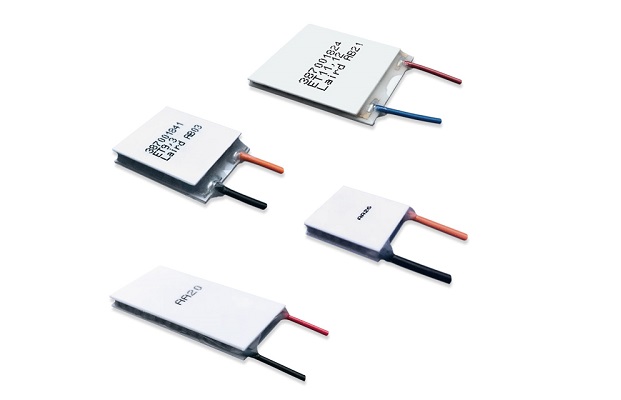
Global technology leader Laird has expanded its thermoelectric module (TEM) product family to protect critical electronic devices in emerging applications found in high-temperature environments. This typically occurs in outdoor environments where heat generated from surrounding electronics exceeds the temperature of sensitive electronics with maximum operating temperatures of 60~70 degree C. The HiTemp ET Series delivers spot cooling to ensure the maximum temperature of the device is not exceeded in ambient environments greater than its maximum operating temperature.

The HiTemp ET Series launch includes 53 models for engineers to choose from with a wide range of heat pumping capacities, geometric form factors and various input voltages to cover the wide range of applications Laird is gaining exposure to. Laird’s enhanced TEM construction prevents copper diffusion, which commonly occurs for standard grade TEMs in higher temperature environments and prevents degradation in their performance. The HiTemp construction also does not sacrifice performance for reliability like other high-temperature modules on the market. The product series maintains a high coefficient of performance (COP) to allow for maximum heat rejection into air environment even with poor heat sinking.


Many sensitive devices, such as lasers and CMOS sensors, are designed into autonomous systems for collision avoidance in vehicles and drones. Digital light processors (DLP) are used in 3-D machine vision, advanced lighting systems and projectors that may also require cooling in outdoor environments where ambient temperatures exceed its maximum operating temperature condition.

“Depending on the application, active cooling may be required to maintain temperatures of sensitive electronics below their maximum operating temperature. The HiTemp ET Series is a preferred cooling method due to its proprietary construction that has shown to not degrade in this environment,” said Anders Kottenauer, Senior Vice President of Laird’s Thermal Systems Business.

For more information, visit lairdtech.com.

ELE Times Research Desk
ELE Times Research Deskhttps://www.eletimes.ai
ELE Times provides a comprehensive global coverage of Electronics, Technology and the Market. In addition to providing in depth articles, ELE Times attracts the industry’s largest, qualified and highly engaged audiences, who appreciate our timely, relevant content and popular formats. ELE Times helps you build awareness, drive traffic, communicate your offerings to right audience, generate leads and sell your products better.

Related News

Must Read

Indigenous BMD Programme Advances with Successful Multi-Layered Interceptor Trials

The Indian Ballistic Missile Defence (BMD) Programme introduced by...

Plug-and-Play 90W PoE Solution Streamlines Industrial IoT Deployments

As industrial environments become more automated and connected, demand...

India Cuts Duty to 0% on 85 Electronics Categories, Leading Global Manufacturers to Invest in India

While accelerating towards manufacturing modern semiconductor technologies, India has...

NIDAR 2.0: MeitY Boosts Indigenous Drone Innovation with India’s Homegrown Chips

The Ministry of Electronics and Information Technology (MeitY) with...

Microchip Advances Neural Network Implementation with VectorBlox 3.0 Accelerator SDK

Deploying AI inference in powerconstrained and missioncritical environments such as...

Indian Deep-Tech Startup Meine Electric’s Fast-Charging Iron-Air Battery Clears Independent Validation, Paving the Way for 24/7 Renewable Energy Storage

Indian deep-tech startup Meine Electric has developed the world's first fast-charging iron-air battery system, marking a significant technical advancement for long-duration energy storage (LDES). The technology, which features a proprietary Fast Charge Long Discharge (FCLD) capability allowing the battery to charge in 6 hours and discharge over 18 hours, has been independently validated by Customized Energy Solutions (CES), a US-headquartered global energy services and technology company and the parent organization of the India Energy Storage Alliance (IESA). The independent testing was conducted by the CES Battery Laboratory through a structured testing...

