
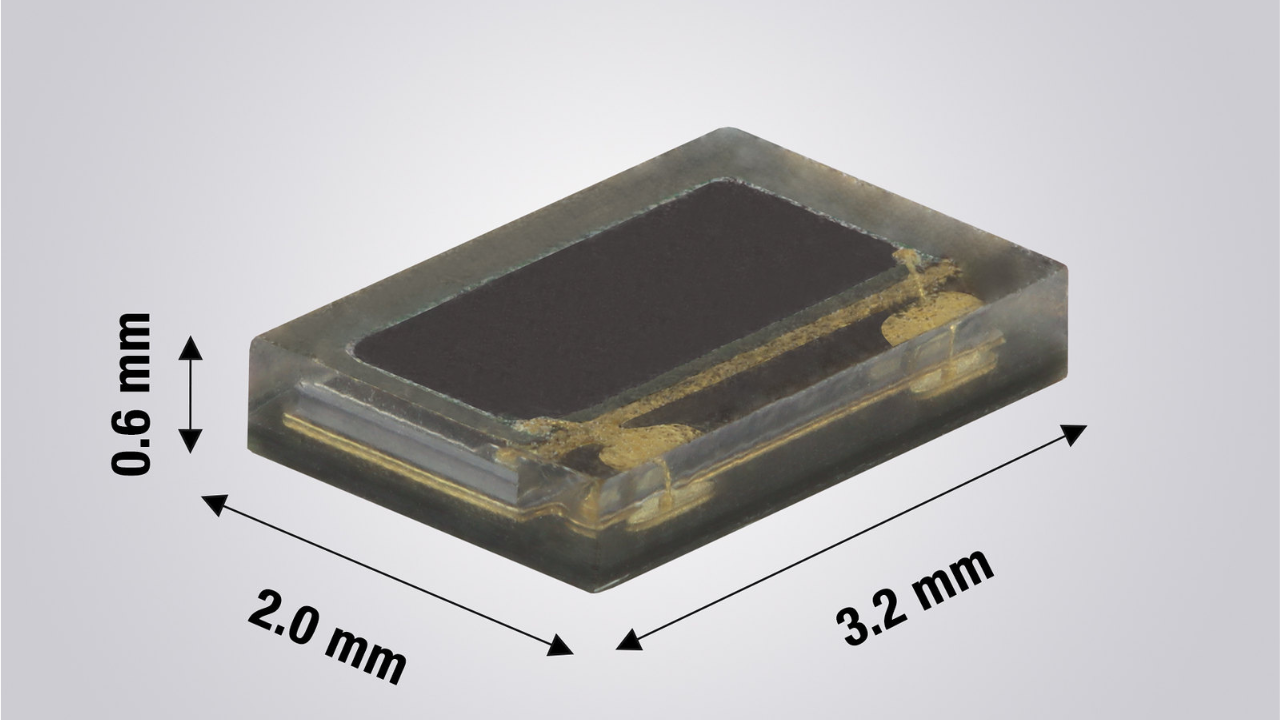
Vishay Intertechnology, Inc. introduced a new high speed silicon PIN photodiode with enhanced sensitivity to visible and infrared light. Featuring a compact 3.2 mm by 2.0 mm top-view, surface-mount package with a low 0.6 mm profile, the Vishay Semiconductors VEMD8083 features high reverse light current and fast response times for improved performance in biomedical applications such as heart rate and blood oxygen monitoring.
The device offers a smaller form factor than previous-generation solutions, allowing for integration into compact wearables, such as smart rings, and consumer health monitoring devices. However, while its chip size is reduced, the photodiode’s package is optimized to support a large radiant sensitive area of 2.8 mm², which enables high reverse light current of 11 μA at 525 nm, 14 μA at 660 nm, and 16 μA at 940 nm.




The VEMD8083’s high sensitivity is especially valuable in biomedical applications like photo plethysmography (PPG), where it detects variations in blood volume and flow by measuring light absorption or reflection from blood vessels. Accurate detection in these scenarios is essential for diagnosing and monitoring conditions such as cardiovascular disease.
Pin to pin compatible with competing solutions, the device detects visible and near infrared radiation over a wide spectral range from 350 nm to 1100 nm. For high sampling rates, the VEMD8083 offers fast rise and fall times of 30 ns and diode capacitance of 50 pF. The photodiode features a ± 60° angle of half-sensitivity and an operating temperature range of -40 °C to +85 °C.
RoHS-compliant, halogen-free, and Vishay Green, the device provides a moisture sensitivity level (MSL) of 3 in accordance with J-STD-020 for a floor life of 168 hours.
Samples and production quantities of the VEMD8083 are available now.

