
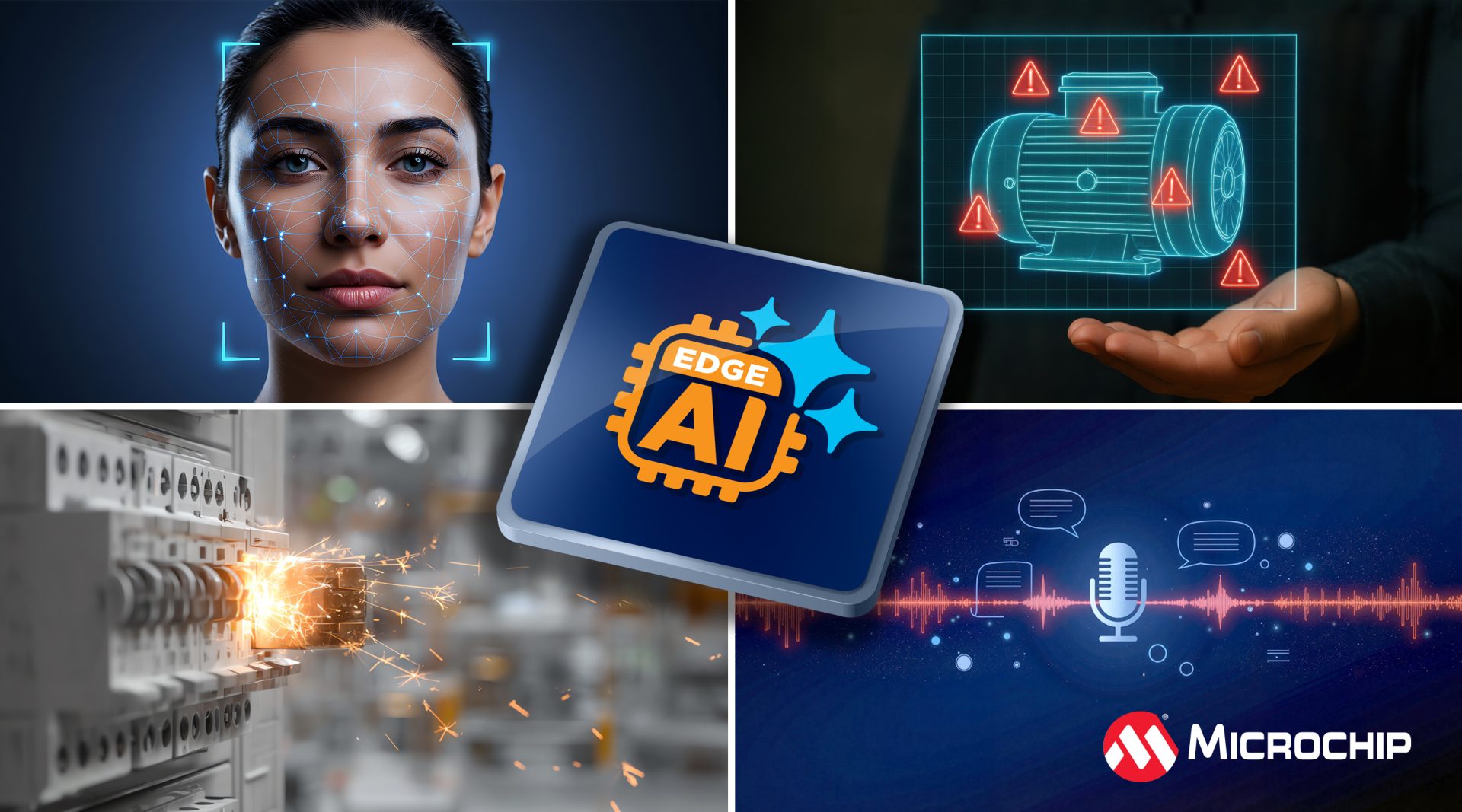
A major next step for artificial intelligence (AI) and machine learning (ML) innovation is moving ML models from the cloud to the edge for real-time inferencing and decision-making applications in today’s industrial, automotive, data center and consumer Internet of Things (IoT) networks. Microchip Technology has extended its edge AI offering with full-stack solutions that streamline the development of production-ready applications using its microcontrollers (MCUs) and microprocessors (MPUs) – the devices that are located closest to the many sensors at the edge that gather sensor data, control motors, trigger alarms and actuators, and more.
Microchip’s products are long-time embedded-design workhorses, and the new solutions turn its MCUs and MPUs into complete platforms for bringing secure, efficient and scalable intelligence to the edge. The company has rapidly built and expanded its growing, full-stack portfolio of silicon, software and tools that solve edge AI performance, power consumption and security challenges while simplifying implementation.




“AI at the edge is no longer experimental—it’s expected, because of its many advantages over cloud implementations,” said Mark Reiten, corporate vice president of Microchip’s Edge AI business unit. “We created our Edge AI business unit to combine our MCUs, MPUs and FPGAs with optimised ML models plus model acceleration and robust development tools. Now, the addition of the first in our planned family of application solutions accelerates the design of secure and efficient intelligent systems that are ready to deploy in demanding markets.”
Microchip’s new full-stack application solutions for its MCUs and MPUs encompass pre-trained and deployable models as well as application code that can be modified, enhanced and applied to different environments. This can be done either through Microchip’s embedded software and ML development tools or those from Microchip partners. The new solutions include:
- Detection and classification of dangerous electrical arc faults using AI-based signal analysis
- Condition monitoring and equipment health assessment for predictive maintenance
- Facial recognition with liveness detection supporting secure, on-device identity verification
- Keyword spotting for consumer, industrial and automotive command-and-control interfaces
Development Tools for AI at the Edge
Engineers can leverage familiar Microchip development platforms to rapidly prototype and deploy AI models, reducing complexity and accelerating design cycles. The company’s MPLAB X Integrated Development Environment (IDE) with its MPLAB Harmony software framework and MPLAB ML Development Suite plug-in provides a unified and scalable approach for supporting embedded AI model integration through optimised libraries. Developers can, for example, start with simple proof-of-concept tasks on 8-bit MCUs and move them to production-ready high-performance applications on Microchip’s 16- or 32-bit MCUs.
For its FPGAs, Microchip’s VectorBlox Accelerator SDK 2.0 AI/ML inference platform accelerates vision, Human-Machine Interface (HMI), sensor analytics and other computationally intensive workloads at the edge while also enabling training, simulation and model optimisation within a consistent workflow.
Other support includes training and enablement tools like the company’s motor control reference design featuring its dsPIC DSCs for data extraction in a real-time edge AI data pipeline, and others for load disaggregation in smart e-metering, object detection and counting, and motion surveillance. Microchip also helps solve edge AI challenges through complementary components that are required for product design and development. These include PCIe® devices that connect embedded compute at the edge and high-density power modules that enable edge AI in industrial automation and data centre applications.
The analyst firm IoT Analytics stated in its October 2025 market reportthat embedding edge AI capabilities directly into MCUs is among the top four industry trends, enabling AI-driven applications “…that reduce latency, enhance data privacy, and lower dependency on cloud infrastructure.” Microchip’s AI initiative reinforces this trend with its MCU and MPU platforms, as well as its FPGAs. Edge AI ecosystems increasingly require support for both software AI accelerators and integrated hardware acceleration on multiple devices across a range of memory configurations.

