
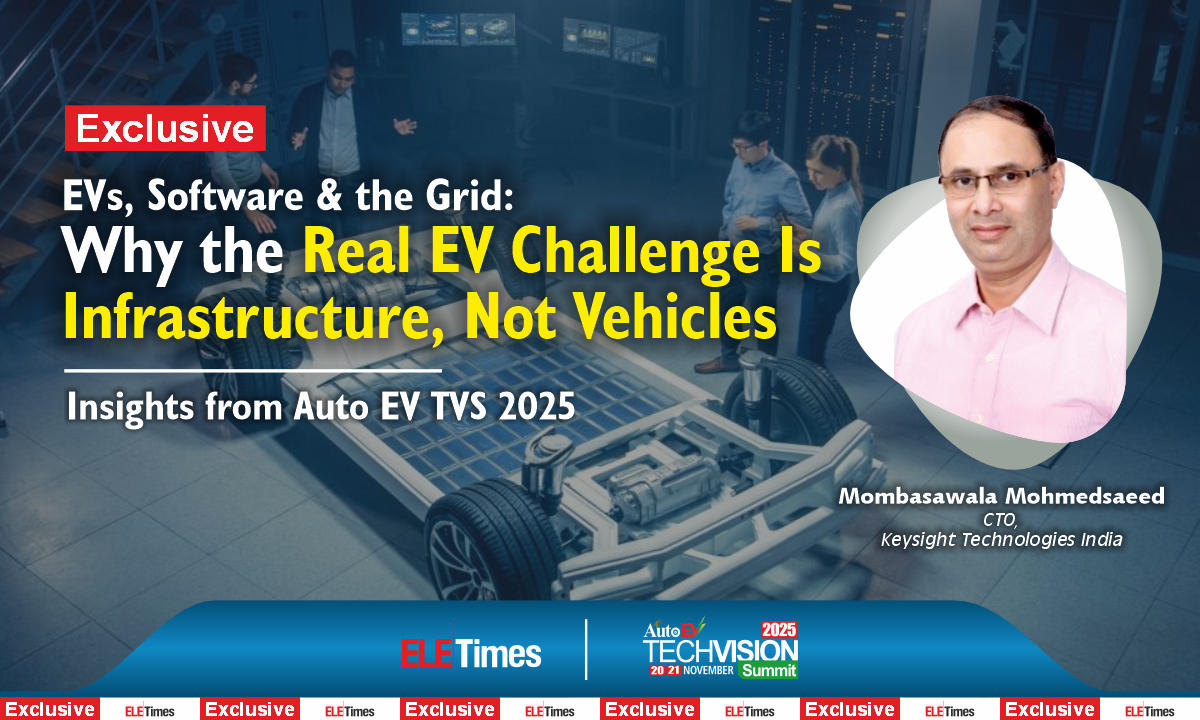
Speaking at the Auto EV Tech Vision Summit 2025, Mohammadsaeed Mombasawala laid bare a reality the EV industry often skirts around—electric vehicles are evolving fast, but the ecosystem supporting them is dangerously lagging.
Opening his address with a provocative question—“Is EV done and dusted?”—Mombasawala was quick to answer it himself: far from it. Innovation in EVs is accelerating, but the real battleground is no longer the vehicle alone. It is charging infrastructure, grid readiness, and software-defined architectures that will decide the success or failure of the transition.




Charging Anxiety Will Not Be Solved with AC
According to Mombasawala, EV charging anxiety cannot be addressed with slow, AC charging solutions. The industry is inevitably moving towards high-power DC fast charging, with capacities of 50 kW and above becoming the new norm.
But charging speed alone is not enough. He highlighted the emergence of plug-and-play charging, where vehicles authenticate themselves automatically through preloaded scripts and cloud connectivity—eliminating the need for RFID cards or manual authentication. In this model, the vehicle communicates with the charger via the cloud, pre-authorises itself, and begins charging seamlessly, reflecting the deeper convergence between EVs and software-defined vehicles (SDVs).
Vehicle-to-Grid: Opportunity Born from Crisis
One of the most critical trends Mombasawala pointed to was Vehicle-to-Grid (V2G) —using EVs not just as consumers of electricity, but as mobile energy sources capable of feeding power back into the grid.
This, he explained, is not just a technological curiosity, but a necessity born from a looming crisis. “I have done the calculation myself,” he noted. If all vehicles in Delhi were replaced with EVs and charged using 50 kW fast chargers, the grid would require 7,000 MW of additional power just to charge vehicles within 5–8 minutes. No grid today is prepared for that kind of load”.
The implication is stark: while EV adoption is racing ahead, grid infrastructure is nowhere close to ready.
The Grid Is the Real Bottleneck
Mombasawala warned that without serious innovation and investment in electrical infrastructure, a rapid EV transition could destabilise the power system itself.
“If we transition the whole country by 2030 at this pace, the grid will collapse,” he cautioned. The issue is no longer just EV range anxiety—it is national power security. Without infrastructure upgrades, consumers may find themselves unable to charge vehicles and facing power shortages at home.
Electrical engineers, he stressed, have a monumental role ahead—not just in vehicles, but in re-architecting the grid to handle electrified mobility at scale.
Software-Defined Vehicles: Complexity Beneath the Surface
While SDVs are often discussed as sleek, updatable platforms, Mombasawala highlighted the hidden complexity beneath the headlines. Today’s vehicles contain hundreds of ECUs communicating through multiple discrete protocols. The industry urgently needs standardisation, moving towards Ethernet-based architectures to manage growing data and control demands.
He also pointed to emerging semiconductor trends such as chiplets, where optics and semiconductors are packaged together in a single die—underscoring how vehicle electronics are becoming more sophisticated and tightly integrated.
Why the Cloud Is Non-Negotiable
A recurring theme in his address was the absolute necessity of cloud backends for SDVs. With millions of vehicles requiring continuous updates, feature upgrades, and service enhancements, localised solutions are no longer viable. “There is no red reset button,” he reminded the audience. Without cloud-based services, upgrading and managing vehicle software at scale becomes impossible.
AI, Data Centres and the Limits of In-Vehicle Intelligence
One of the most sobering insights came from Mombasawala’s discussion on AI in SDVs. Advanced vehicle functions—braking behaviour, acceleration profiles, comfort tuning—will increasingly rely on AI models trained on massive datasets. But these models cannot be trained inside vehicles.
To put scale into perspective, he cited how companies like Meta use around 600,000 GPUs, while Elon Musk’s Grok reportedly uses 800,000 GPUs in a single data centre. Even with such resources, training models can take weeks. Training safety-critical vehicle systems like braking could require 6–8 weeks per iteration, and continuous retraining as new data arrives.
This underscores a key reality: SDVs are as much a data-centre problem as they are an automotive one.
Beyond the Hype
Mombasawala concluded by grounding expectations around SDVs. While the stories sound exciting, real-world vehicle control systems only stabilise through negative feedback loops, making their design and validation far more complex than popular narratives suggest. The EV transition, he implied, will not be won by flashy announcements alone. It will require deep engineering, infrastructure investment, and a sober understanding of system-level constraints.
As the industry pushes ahead, his message was clear: the future of EVs depends not just on better vehicles, but on grids, software, clouds, and engineers rising together.

