

3D printed metal and electronics company Optomec, has been awarded a NASA Small Business Innovation Research (SBIR) contract to continue development of its Adaptive Laser Sintering System (ALSS).
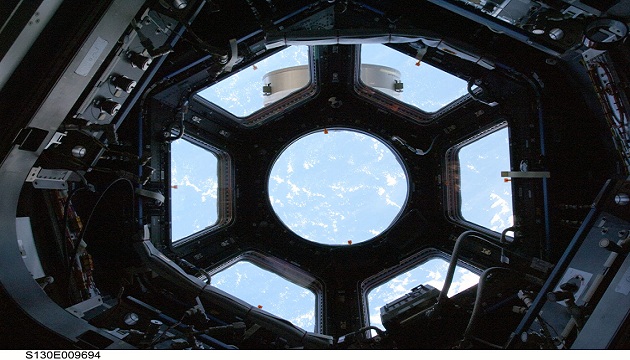
Used as a post processing system for metal 3D printing, ALSS will enable electronics 3D printing onto a wider variety of temperature sensitive substrates, specifically for use on the International Space Station (ISS) in microgravity conditions.




An automated process with faster production time
ALSS is an automated method of post processing that dries, and fuses to together, the particles of a 3D printed electronic ink. As a sintering method specially developed for electronics, ALSS makes it easier for customers to achieve the desired result in their prints. It also significantly reduces typical production time and need for human intervention.
The technique is under development by Optomec in collaboration with Harding University in Arkansas. Commenting on the partnership Edmond Wilson, Professor of Chemistry at Harding, expresses his enthusiasm for the project commenting,
 Successful development of laser assisted drying and sintering of 3D printed electronics will greatly reduce the production time for 3D printed electronics devices and substantially reduce the need for human intervention. We look forward to mentoring student researchers and help them jump start their careers by tackling cutting edge technology problems.
Enhancing direct-write technologies
As stated in the SBIR proposal, NASA commercial applications will look at applying the system “to compare and evaluate the advantages of printing electronics using different direct-write technologies,” including Optomec’s proprietary Aerosol Jet technique, inkjet printing, other metal nanoparticle ink dispensing methods and plasma jet printing technology.
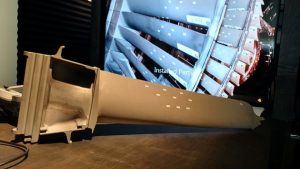
Non-NASA commercial applications on the other hand will focus solely on applying ALSS to micron-level Aerosel Jet 3D printed electronics, to “increase its production capability and market share.” An example of such applications include the sensors Optomec 3D printed onto the surface of GE turbine blades.
A solution to NASA’s “in-space, on-demand manufacturing capabilities”
 Beth Paquett, Aerospace Engineer at NASA Goddard Space Flight Center, has thus far been leading research into the space applications for Optomec’s Aerosol Jet technology. Findings published by Paquett in 2016 found that printed gold inks were better at meeting in-space requirements, and further research was to be done into developing a cheaper, silver-based alternative.
Specifically for in-space application Optomec CTO, Mike Renn, explains,
After the successful design, test and implementation of ALSS, the science and technology of laser sintering will be better understood for controllable adaptive operations. ALSS can be a key solution to NASA’s challenge of in-space, on-demand manufacturing capabilities to support the unique challenges of long-duration human spaceflight, which requires an automated adaptive in-line quality control system along with the associated manufacturing process.
-

