
HomeElectronicsRenewable EnergyPerovskite Solar Cell with High Efficiency and Stability

    Perovskite Solar Cell with High Efficiency and Stability

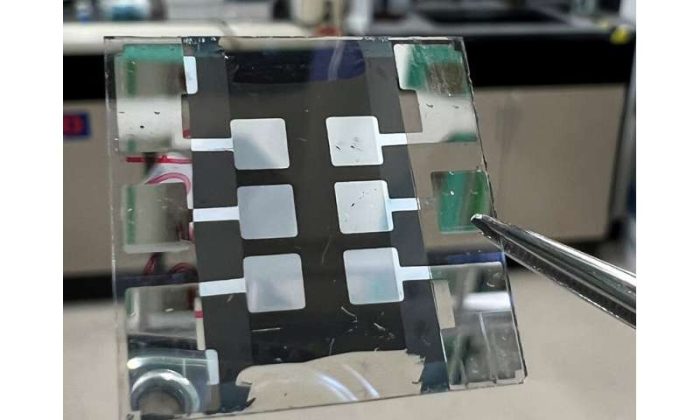
    Researchers at the U.S. Department of Energy’s (DOE’s) National Renewable Energy Laboratory (NREL) have made a technological breakthrough and constructed a perovskite solar cell with the dual benefits of being both highly efficient and highly stable.

    The work was done in collaboration with scientists from the University of Toledo, the University of Colorado-Boulder, and the University of California-San Diego.


    A unique architectural structure enabled the researchers to record a certified stabilized efficiency of 24% under 1-sun illumination, making it the highest reported of its kind. The highly efficient cell also retained 87% of its original efficiency after 2,400 hours of operation at 55 degrees Celsius.

    Perovskite, which refers to a crystalline structure, has emerged in the last decade as an impressive means to efficiently capture sunlight and convert it to electricity. Research into perovskite solar cells has been focused to a large degree on how to increase their stability.

    “Some people can demonstrate perovskites with high stability, but efficiency is lower,” said Zhu, a senior scientist in the Chemistry and Nanoscience Center at NREL. “You ought to have high efficiency and high stability simultaneously. That’s challenging.”

    The researchers used an inverted architecture, rather than the “normal” architecture that has to date yielded the highest efficiencies. The difference between the two types is defined by how the layers are deposited on the glass substrate. The inverted perovskite architecture is known for its high stability and integration into tandem solar cells. The NREL-led team also added a new molecule, 3-(Aminomethyl) pyridine (3-APy), to the surface of the perovskite. The molecule reacted to the formamidinium within the perovskite to create an electric field on the surface of the perovskite layer.

    “That suddenly gave us a huge boost of not only efficiency but also stability,” Zhu said.

    The scientists reported that 3-APy reactive surface engineering can improve the efficiency of an inverted cell from less than 23% to greater than 25%. They also noted that reactive surface engineering stands out as an effective approach to significantly enhance the performance of inverted cells “to new state-of-the-art levels of efficiency and operational reliability.”

    ELE Times Research Desk
    ELE Times Research Deskhttps://www.eletimes.ai
    ELE Times provides extensive global coverage of Electronics, Technology and the Market. In addition to providing in-depth articles, ELE Times attracts the industry’s largest, qualified and highly engaged audiences, who appreciate our timely, relevant content and popular formats. ELE Times helps you build experience, drive traffic, communicate your contributions to the right audience, generate leads and market your products favourably.

    Related News

    Must Read

    R&S showcases its comprehensive embedded systems test solutions at embedded world 2026

    Rohde & Schwarz will present its advanced test and...

    Toxics Link study Finds a Long Road to Circularity in India’s E-waste EPR Model

    A new report by an environmental group, Toxics Link,...

    ESGDS’ AI platform slashes data processing time by 98% with MongoDB Atlas

    ESG Data & Solutions (ESGDS) is a fast-growing Indian...

    Keysight Unveils 3D Interconnect Designer for Chiplet and 3DIC Advanced Package Designs

     Keysight Technologies introduced 3D Interconnect Designer, a new addition to...

    Jodi Shelton, CEO of GSA – Launches A Bit Personal, a New Podcast Offering Rare, Candid Conversations with the Most Powerful Tech Leaders

    Jodi Shelton, Co-Founder and CEO of the Global Semiconductor Alliance and Shelton...

    Is SDV Really an Automotive or Just A Software-based machine That Moves?

    Speaking at the Auto EV Tech Vision Summit 2025,...

    ROHM’s New Compact, Highly Reliable Package Added to Automotive 40V/60V MOSFET Lineup

    ROHM has expanded its lineup of low-voltage (40V/60V) MOSFETs...

    The Rise of the AgentEngineer: How AI is Orchestrating the Future of Chip Design

    While traditional Electronic Design Automation tools have been faithfully...

    IIIT Hyderabad’s Smart Approach To Sand Mining Enforcement, Incorporating AI in Trucks

    ‘Truck art’ or the hand-painted ‘Horn Ok Please’, ‘Use...

    Applied Materials, CG Power, Lam Research, Larsen & Toubro, and Micron Join the IDTA

    The India Deep Tech Alliance (IDTA) announced that Applied...

