

Abhishek Pandey | Sub-Editor | ELETimes
“How little smart robots in swarms are revolutionizing farming; one field at a time.”



Agriculture’s history has always been based on years of experience, sheer muscle, and eventually- better machines. Farming tools like tractors grew bigger, irrigation more complex, and harvest more automated. But even with all this progress, many of today’s agriculture issues- labour scarcity, inclement weather, skyrocket costs, depleted soil and the demand for more food- seems harder than ever to solve.
What if the future farming technology wasn’t about big machines and instead would use thousands of smaller ones to collaborate like an ant colony?
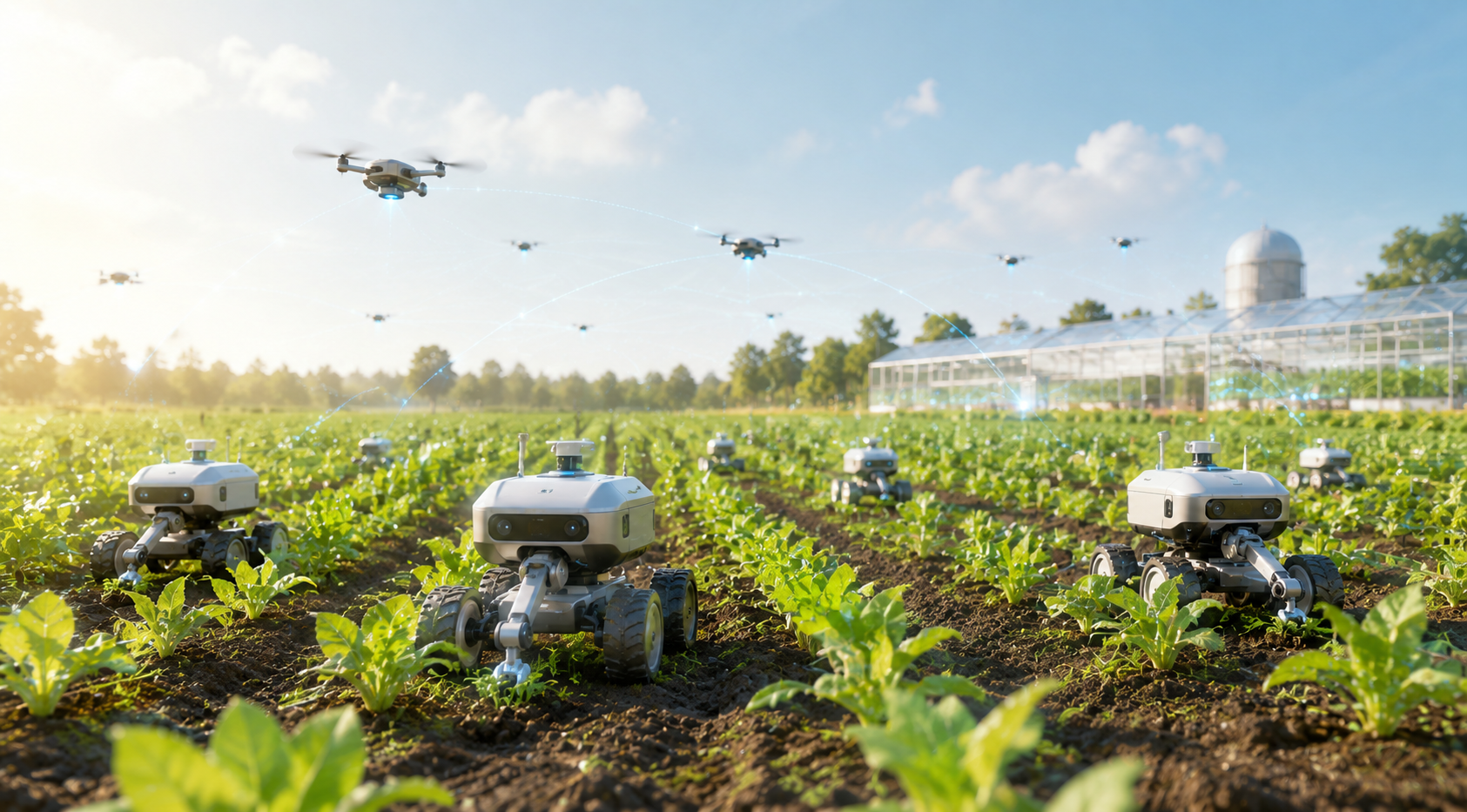
But this isn’t just future science fiction anymore. We already see teams of robotics swarmer’s-teams of small, autonomous bots working together in a group to coordinate actions, communicate, and make collective decisions-at the hands of university researchers and agricultural tech firms. Using cutting- edge AI and loT, a tight wireless connection, Edge AI, these minute devices are re-shaping how we cultivate, protect, watch, and harvest our food.
Farmers of the future will perhaps abandon expensive machinery in favour of a hundred robots the size of shoebox collaborating with a hive mind, say scientists who drew inspiration for their robot swarm from living creatures. It will adapt and regroup on the fly, even if one of its number malfunctions.
Teamwork: A Lesson from Nature’s Strongest Alliance
It might therefore surprise you that swarm robotics didn’t start out in some engineering lab. Instead, it began with observation in nature. Bees build intricate underground nests that never had any leader to order each individual around. They would fly in coordinated swarms to protect their nest and gather food. Bees have the ability to marshal thousands of workers together and fly in formations, their flight directions will adjust by themselves depending on the directions of adjacent rather than order from the commander.
Together that enables an extraordinary smart system to function based on a number of individuals’ quite simple activities. Inspired by such an instinct, the engineers adopted the concept of the design to implement the concept of swarm robotics- a discipline that entails many-or sometimes a hundred-small robots units working together for tasks that could otherwise not be achieved by a solitary unit. Each unit senses the surrounding, communicates it to its close peers and modifies its behaviour according to the information aggregated.
This collective intelligence, known as a “Hive Mind” is swarm robots, is one of the reasons that this emerging field of robots, sometimes referred to as swarm intelligence, is such a rapidly growing area for research and robotics in general.
The Need for a New Agriculture
The amount of pressure being placed on modern day farming today is huge. Weather and the climate have become increasingly unpredictable with climate change. Water resources are dwindling in many regions. There is a global need for increased food production with fewer resources, in a manner that protects the environment.
Meanwhile, many countries are encountering shortages in labour supplies and there have always been issues finding workers to support agriculture planting and harvesting. Many traditional solutions to some of these issues create others, though. Large tractors can pack the soil, guzzle a lot of fuel and often approach entire fields in the same manner, even when the crop will not require the same treatment for every square foot of the field.
This is exactly where precise agriculture starts to kick into gear. So instead of spraying a field with one spray the technology can be used to determine exactly what the individual part needs for precision agriculture. Robot swarms take it to the extreme allowing thousands of small decisions to be made constantly throughout a field.
Small Bots with Huge Responsibilities
It’s not the one machine to do it all that is forming the basis for the agriculture robot swarms. Instead, responsibilities are shared.
The robot inspects the moisture level of the soil or checks the nutrients level of the plants. Other robots can scan fields to pinpoint weeds or monitor crop health from up in the air using drones and look at single plants up close with robots on the ground. Some even deliver a precise dose of pesticides or fertilizer just where the plant needs it.
If one robot detects something abnormal, it alerts its robot peers, which can help further assess the situation, and coordinate actions. This constant communication ensures that the farms are able to respond in a far more dynamic way that older farming systems ever could.
The Role of AI and Edge Computing
The brain power comes in the form of AI and Edge AI technology for these robots. Instead of transmitting all images and sensor data back to faraway cloud servers, the majority of robots process them in real-time, so they can react to shifting field conditions. If, for instance, a robot notices a weird pattern in leaf discoloration, it doesn’t need to pause for seconds or minutes while it’s being told what to do.
The robot can scan a picture, compare it to its earlier recordings, and can send nearby robots the signal nearly in real time. Combining this local knowledge with the power of coordinated communication enables the development of a quicker and more robust farming system.
Precision Farming Done Right
The great thing about swarm robotics is that they are capable of being very precise. Some traditional spray equipment has the capacity to apply treatment across a whole field without differentiating between individual plants. But there are many plants which will never receive a benefit from pesticide or fertilizer applications. On the other hand, swarm robot design is more open.
Through the use of cameras, sensors, and artificial-intelligence image recognition, they can tell weeds apart from the plants or can identify if the plant has deficiency and needs more food. Why spray everything on the meter area, when it is not necessarily the problem. This leads to less chemical input, more healthy soil, reduced production costs and increased crop quality. That adds up to more efficient farming- while keeping it sustainable.
Benefits Even Beyond Work Productivity
However, the benefit of robotic swarms isn’t only to increase output. Heavy machinery for agriculture presses on the ground with more weight, while light weights robots make less pressure on the soil thus saving the structure for a long time.
Their electric system reduces reliance on the combustion of fossil fuel, which means lower emissions of carbon dioxide. As farmers always keep an eye on their crop, they are alerted of potential pests, diseases, lack of water or deficiency in any of the necessary nutrients at a much early stage. The very fact that problems can be spotted much easier ensures that they don’t snowball into big losses.
Swarm systems collect useful information to make better planning for the future as well. A farmer will know better on how his performance has been during a season and identify the repetitive problems encountered each season so as to have a better planning on what he or she needs to harvest next.
Trails That May Be Faced on the Journey Forward
While the technology is promising, the applications of swarm robotics are still a work in progress. The difficult and complex engineering task of producing low-cost, robust robots capable of withstanding challenging weather is a key priority for robotics researchers worldwide. Harsh environments-characterized by dust, rain, mud, rough terrain-pose significant hurdles for autonomous machines. Battery power is also another issue which limits how long robots, particularly small, heavy robots equipped with sensors, can be operational.
Hundreds of autonomous machines to stay secure, reliable and resilient, as cybersecurity is rapidly becoming a vital aspect of every automation process. There are also questions of economic nature. Despite the fact that robotic swarms help cut down expenses in the long run, a farmer on a small scale might find a steep initial investment to be a burden if they can’t obtain funding, or set up a cooperative model to share these expenses.
A Smart Future for Farming
The researchers think that it is early days for the technology. In the future, farming might involve integrated networks of autonomous tractors, swarms of robotics weeders and harvesters, aerial drones, satellites, weather models, and AI-powered analytics, forming a smart farming ecosystem.
Rather than being a substitute for farmers, these tools will likely be excellent decision-making support tools that enable the farmers to use their experience, intuition, and judgement along with robots taking care of very specific, laborious, and highly repeatable and high precision tasks. Technologies are being rapidly developed in the 5G, Edge AI, robotics and sensor spheres that are making fully integrated smart farming closer than ever.
Conclusion
For centuries, technology has been driving innovation in agriculture, from handheld implements and animal-powered plows to automated machinery and GPS-guided tractors. This latest agriculture revolution may not come in larger machines, but in millions of smaller, more intelligent ones.
Bur swarm robotics, artificial intelligence-assisted farming and precision agriculture, for example, indicate that the ways in which we can grow food in the future could be entirely different, with help from miniature robots coordinated like nature’s own organized swarms and ant colonies. The key: They’re showing that smart behaviour doesn’t always reside within an individual, highly intelligent system, but can be generated from multiple, cooperating units working together towards a collective objective.
And if this picture continues to evolve, the farm of tomorrow won’t just be automatic, but cooperative, fluid, connected and profoundly effective. Tomorrow, the tiniest hands can get the biggest job done in a field.

