

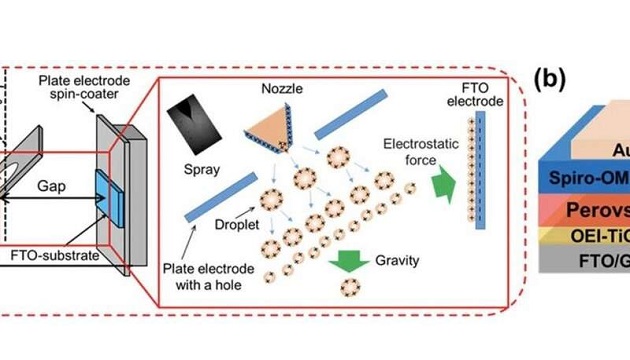
The need to efficiently harvest solar energy for a more sustainable future is increasingly becoming accepted across the globe. A new family of solar cells based on perovskites, materials with a particular crystal structure, is now competing with conventional silicon materials to satisfy the demand in this area. Perovskite solar cells (PSCs) are continually being optimized to fulfill their commercial potential, and a team led by researchers from Kanazawa University has now reported a new and simple oblique electrostatic inkjet (OEI) approach to deposit a titanium oxide (TiO2) compact layer on FTO-pattern substrates without the need for a vacuum environment as an electron transport layer (ETL) for enhancing the efficiency of PSCs. The findings are published in Scientific Reports.
The PSCs comprise a stack of different component layers that all have a specific role. The ETL, which is often composed of TiO2, enables the transport of electrons, which carry charge, to the electrodes, while blocking the transport of holes, which can recombine with electrons to prevent their flow. Establishing a complete TiO2 layer with the correct thickness, which is uniform and free of flaws, is therefore critical to producing efficient solar cells.




Many of the numerous TiO2 deposition techniques reported to date have associated limitations, such as poor coverage or reproducibility, or being unsuitable for scale-up. They can also require challenging preparation conditions such as a vacuum. The researchers report a simple, low-cost OEI-method that achieves a compact layer without requiring a vacuum.
“Our technique can produce uniform electron transport layers whose thickness can be varied by controlling the deposition time.” Study lead author Assistant Professor Dr. Md. Shahiduzzaman explains. “Solar cells made using our approach had power-conversion efficiencies of up to 13.19%, which, given the other advantages of our technique, is very promising for scale-up and commercialization.”
The technique is based on the deposition of positively charged droplets that are attracted to a negatively charged surface. Previous reports using the same electrostatic approach achieved lower power-conversion efficiencies because the droplets formed a stack on the surface as a result of gravity. Introducing an oblique angle into the process, spraying the TiO2 precursor at 45° to the surface, eliminated the effect of gravity, leading to the deposition of a more uniform layer.
“An optimum ETL deposition method must offer a number of properties to result in a high efficiency solar cell,” Dr. Shahiduzzaman explains. “The ability to control the layer thickness and achieve a uniform, reproducible layer at low cost, without the need for a vacuum, provides a unique package of advantages that has not been reported to date. We hope that these properties will lead to effective and commercially relevant scale-up that will contribute to the drive towards cleaner energy worldwide.”

