
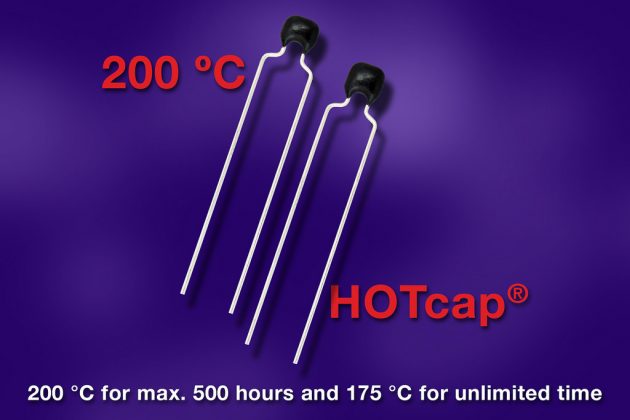
Vishay Intertechnology, Inc. on Oct. 30, 2017, announced that the company has extended the operating temperature range of its HOTcap K…H series of Automotive Grade, radial-leaded multilayer ceramic chip capacitors (MLCCs) to +200 °C — the industry’s highest for Ceramic Class 2 through-hole devices.
The Vishay BCcomponents leaded MLCCs are now approved for operation over a temperature range of -55 °C to +200 °C for 500 hours and they provide an unlimited operation to +175 °C. The devices combine their high-temperature performance with a wide capacitance range from 100 pF to 1 μF and low capacitance tolerances as tight as ± 5 %.




Ideal for EMI filtering in sensors and DC motors in the most extreme automotive environments, K…H series capacitors are equipped with a high-reliability MLCC insert produced in a unique wet build process and featuring noble metal electrodes. AEC-Q200 qualified with PPAP available on request, the leaded MLCCs are more robust to mechanical stress and can withstand higher operating temperatures than SMD parts while saving space by eliminating the need for a PCB.
The Ceramic Class 1 and 2 MLCCs feature an ultra-stable C0G dielectric with a capacitance change of ± 30 ppm/K and an X0U dielectric with TCC of +22 % / -56 % from -55 °C to +175 °C. The X0U dielectric also fulfills the X7R specification of ± 15 % from -55 °C to +125 °C and the X9V specification of +22 % / -82 % from -55 °C to +200 °C. For direct welding on lead frames and/or overmolding with plastic, the devices offer straight or crimped leads with a spacing of 2.5 mm and 5.0 mm. Their lead wires measure 0.5 mm or 0.6 mm and are constructed of 100 % tinned copper-clad steel.
Lead (Pb)-free, RoHS-compliant, and halogen-free, the capacitors offer a coating made of flame-retardant epoxy resin in accordance with UL 94 V-0.
Device Specification Table:
| Ceramic class |
1 |
2 |
||||
| Ceramic dielectric |
C0G |
X0U |
||||
| Voltage (VDC) |
50 |
100 |
200 |
50 |
100 |
200 |
| Min. capacitance (pF) |
100 |
100 |
100 |
10,000 |
10,000 |
10,000 |
| Max. capacitance (pF) |
12,000 |
12,000 |
8,200 |
1,000,000 |
470,000 |
180,000 |
Samples and production quantities of the extended K…H series are available now, with lead times of eight weeks. Sample kits are available from Vishay’s catalog distributors, with the part number HOTC-KIT-KH.

