
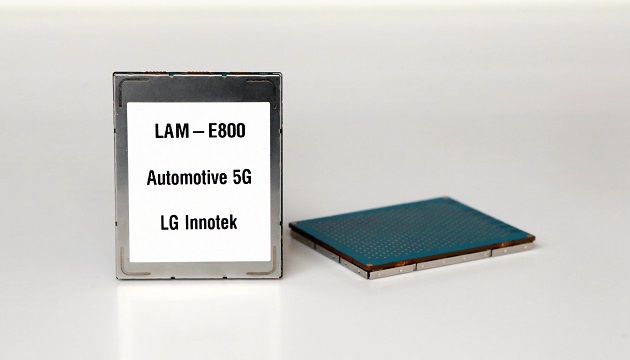
LG Innotek announced it has developed a communication module for automotive based on 5G (5th Generation) Qualcomm chip. The company is the first company to develop a 5G communication module for automotive using Qualcomm chips that can be applied to vehicles.
5G communication module for automotive is a component that uses the 5G mobile telecommunication technology to enable transmission of data between a vehicle and a cellular base station and wireless network connection. This module combines a communication chip, memory, and RF (radio frequency) circuit and is generally mounted on the inside a vehicle or in a vehicle communication device on the roof.




This module makes possible sharing of real-time traffic information, precise location measurement, V2X (Vehicle-to-Everything: communication between a vehicle and objects), and transmission of larger amounts of data. In other words, this module secures the key functions that are needed for entirely autonomous driving that requires no involvement of the driver.
Recently, other companies also have focused on development of 5G communication module, which is a key component of an autonomous vehicle. In particular, companies have been in a fierce competition to successfully develop a module that runs on the Qualcomm Snapdragon Automotive 5G Platform.
However, using the 5G technology for communication modules for automotive was not easy because it uses high frequency bands, causing higher loss of signals than LTE (Long Term Evolution, 4G mobile telecommunication technology) as well as high heat generation due to transmission of larger amounts of data.
To solve this problem, LG Innotek used its proprietary RF circuit design technology, high precision and density modularized technology as well as heat resistant new materials.
The company’s 5G communication module has a low latency (1ms or less), which is one tenth of that of an LTE module. This is why 5G technologies come into the spotlight in autonomous vehicle areas. Because it is require more immediate response to the changes in real-time situations.
Also, this module has higher heat-resistance. It can withstand and is not easily deformed by the high heat generated by 5G network as well as direct sunlight on the vehicle roof. The module uses new plastic materials which are less sensitive to temperature change and is manufactured by applying new engineering methods in the processes of hardening and coating.
The 5G module also comes with software optimized for the module. Another advantage of the product is that it can be used regardless of the region or vehicle type because it follows the 3GPP Release 15, the newest 5G standard, of 3rd Generation Partnership Project (3GPP).
LG Innotek official said, “The successful development of 5G communication module for vehicles will speed up the commercialization of entirely autonomous vehicles and connected cars by manufacturers. Our company will continue to introduce innovative products that can provide drivers with safe, convenient, and enjoyable driving experience.”
For more information, visit: www.lginnotek.com

