
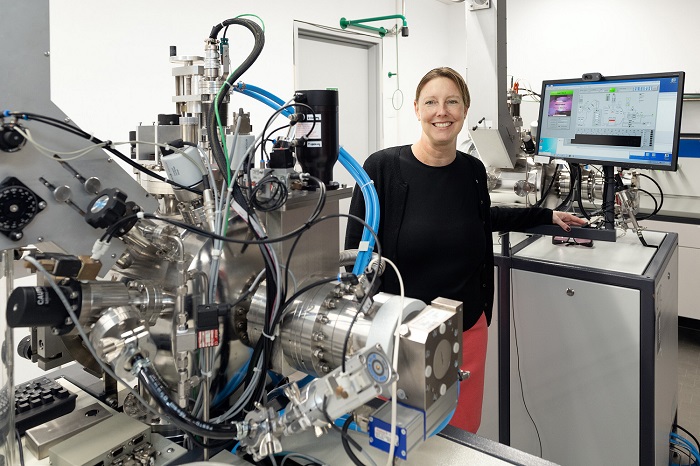
Lithium-ion batteries, fuel cells, and many other devices depend on the high mobility of ions in order to work properly. But there are a large number of obstacles to such mobility. A research team led by Jennifer L. M. Rupp of the Technical University of Munich (TUM) and Harry L. Tuller of the Massachusetts Institute of Technology (MIT) have now shown for the first time that light can be used to increase the mobility of ions and improve the performance of such devices.
A charge can be transported by a material in a number of different ways. The most familiar is the electrical conductivity of metals, where the charge is borne by electrons. In many devices, however, ions transport the charge. One example is lithium-ion batteries in which lithium ions move during charging and discharging. Similarly, fuel cells rely on the transport of hydrogen and oxygen ions in order to conduct electricity.




Ceramics are currently being investigated as solid electrolytes for transporting oxygen ions. But: “What we find is that the ionic conductivity—the rate at which the ions can move and, therefore, how efficient the resulting device can be—is often markedly degraded by the fact that the ions get blocked at grain boundaries,” says Prof. Harry L. Tuller of the Massachusetts Institute of Technology.
Light puts ions on the go
In their current publication Tuller and his colleague Jennifer L. M. Rupp, Professor for solid-state electrolyte chemistry at the Technical University of Munich, show how light can be used to reduce the barriers encountered by ions at ceramic grain boundaries.
Many devices based on ion conductivity, such as solid-oxide fuel cells, have to operate at very high temperatures in order for the ions to be able to overcome the grain boundary barriers. Operating temperatures of up to 700° Celsius, however, present their own challenges: Materials age faster and the infrastructure for maintaining these high temperatures is costly.
“Our dream was to see if we could overcome the barriers using something that doesn’t require heat. Could we get the same conductivities with another tool?” says lead author and Ph.D. student Thomas Defferriere. This tool turned out to be light, which had never been investigated in this context before.
Higher efficiency levels in energy conversion and storage
“Our research shows that illumination of ceramic materials for fuel cells and possibly for batteries in the future can significantly increase ion mobility,” says Rupp. “In gadolinium-doped cerium oxide, a ceramic used as a solid-state electrolyte in fuel cells, illumination increased conductivity at the grain boundaries by a factor of 3.5.”
This newly discovered “opto-ionic effect” could find a wide range of applications in the future. For example, it could improve the performance of solid-state electrolytes in tomorrow’s lithium-ion batteries and thus facilitate higher charging speeds or could pave the way to the development of new electrochemical storage and conversion technologies that work at lower temperatures and achieve higher efficiency levels.
Light can also be precisely focused, making it possible to spatially control the ion flow at exactly defined points or to switch conductivity in ceramic materials.

