
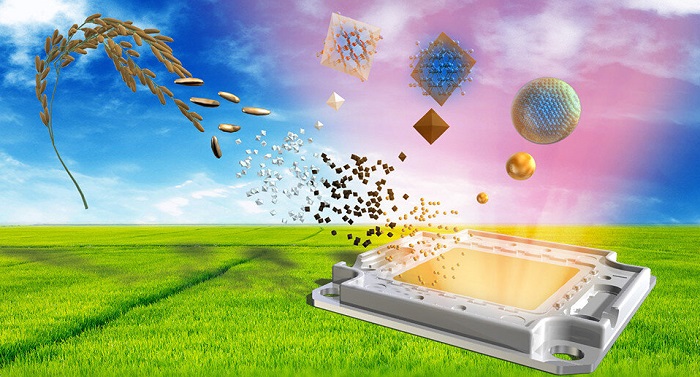
Milling rice to separate the grain from the husks produces about 100 million tons of rice husk waste globally each year. Scientists searching for a scalable method to fabricate quantum dots have developed a way to recycle rice husks to create the first silicon quantum dot (QD) LED light. Their new method transforms agricultural waste into state-of-the-art light-emitting diodes in a low-cost, environmentally friendly way.
“Since typical QDs often involve toxic material, such as cadmium, lead, or other heavy metals, environmental concerns have been frequently deliberated when using nanomaterials. Our proposed process and fabrication method for QDs minimize these concerns,” said Ken-ichi Saitow, lead study author and a professor of chemistry at Hiroshima University.




Since porous silicon (Si) was discovered in the 1950s, scientists have explored its uses in applications in lithium-ion batteries, luminescent materials, biomedical sensors, and drug delivery systems. Non-toxic and found abundantly in nature, Si has photoluminescence properties, stemming from its microscopic (quantum-sized) dot structures that serve as semiconductors.
Aware of the environmental concerns surrounding the current quantum dots, the researchers set out to find a new method for fabricating quantum dots that has a positive environmental impact. Waste rice husks, it turns out, are an excellent source of high-purity silica (SiO2) and value-added Si powder.
The team used a combination of milling, heat treatments, and chemical etching to process the rice husk silica: First, they milled rice husks and extracted silica (SiO2) powders by burning off organic compounds of milled rice husks. Second, they heated the resulting silica powder in an electric furnace to obtain Si powders via a reduction reaction. Third, the product was a purified Si powder that was further reduced to 3 nanometers in size by chemical etching. Finally, its surface was chemically functionalized for high chemical stability and high dispersivity in solvent, with 3 nm crystalline particles to produce the SiQDs that luminesce in the orange-red range with high luminescence efficiency of over 20%.
“This is the first research to develop an LED from waste rice husks,” said Saitow, adding that the non-toxic quality of silicon makes them an attractive alternative to current semiconducting quantum dots available today.
“The present method becomes a noble method for developing environmentally friendly quantum dot LEDs from natural products,” he said.
The LEDs were assembled as a series of material layers. An indium-tin-oxide (ITO) glass substrate was the LED anode; it is a good conductor of electricity while sufficiently transparent for light emission. Additional layers were spin-coated onto the ITO glass, including the layer of SiQDs. The material was capped with an aluminum film cathode.
The chemical synthesis method the team developed has allowed them to evaluate the optical and optoelectrical properties of the SiQD light-emitting diode, including the structures, synthesis yields, and properties of the SiO2 and Si powders and SiQDs.
“By synthesizing high-yield SiQDs from rich husks and dispersing them in organic solvents, it is possible that one day these processes could be implemented on a large scale, like other high-yield chemical processes,” Saitow said.
The team’s next steps include developing higher efficiency luminescence in the SiQDs and the LEDs. They will also explore the possibility of producing SiQD LEDs other than the orange-red color they have just created. Looking ahead, the scientists suggest that the method they have developed could be applied to other plants, such as sugar cane bamboo, wheat, barley, or grasses, that contain SiO2. These natural products and their wastes might hold the potential for being transformed into non-toxic optoelectronic devices. Ultimately, the scientists would like to see the commercialization of this eco-friendly approach to creating luminescent devices from rice husk waste.

