The cellular forms of natural materials are the inspiration behind a new lightweight, 3D printed smart architected material developed by an international team of engineers.
The team, led by engineers from the University of Glasgow, mixed a common form of industrial plastic with carbon nanotubes to create a material which is tougher, stronger and smarter than comparable conventional materials.



The nanotubes also allow the otherwise non-conductive plastic to carry an electric charge throughout its structure. When the structure is subjected to mechanical loads, its electrical resistance changes. This phenomenon, known as piezoresistivity, gives the material the ability to “sense” its structural health.
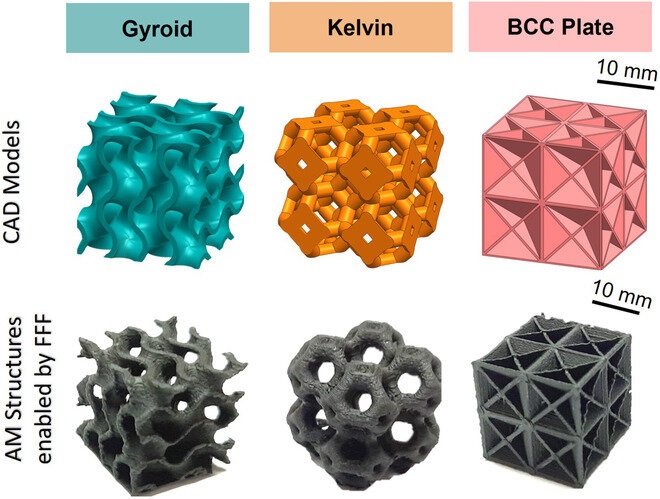
By using advanced 3D printing techniques that provide a high level of control over the design of printed structures, they were able to create a series of intricate designs with mesoscale porous architecture, which helps to reduce each design’s overall weight and maximize mechanical performance.
The team’s cellular designs are similar to porous materials found in the natural world, like beehives, sponges and bone, which are lightweight but robust.
The researchers believe that their cellular materials could find new applications in medicine, prosthetics and automobile and aerospace design, where low-density, tough materials with the ability to self-sense are in demand.
The researchers describe how they investigated the energy absorbing and self-sensing characteristics of three different nanoengineered designs they printed using their custom material, which is made from polypropylene random co-polymer and multi-wall carbon nanotubes.
Of the three designs tested, they found that one exhibited the most effective mix of mechanical performance and self-sensing ability—a cube-shaped “plate-lattice,” which incorporated tightly-packed flat sheets.
The lattice structure, when subjected to monotonic compression shows an energy absorption capacity similar to nickel foams of the same relative density. It also outperformed a number of other conventional materials of the same density.
The research was led by Dr Shanmugam Kumar from the University of Glasgow’s James Watt School of Engineering, alongside colleagues Professor Vikram Deshpande from the University of Cambridge and Professor Brian Wardle from the Massachusetts Institute of Technology.
Dr Kumar said: “Nature has a lot to teach engineers about how to balance properties and structure to create high-performance lightweight materials. We’ve taken inspiration from these forms to develop our new cellular materials, which offer unique advantages over their conventionally produced counterparts and can be finely tuned to manipulate their physical properties.
“The polypropylene random co-polymer we’ve chosen offers enhanced processability, improved temperature resistance, better product consistency, and better impact strength. The carbon nanotubes help to make it mechanically robust while imparting electrical conductivity. We can choose the extent of porosity in the design and architect the porous geometry to enhance mass-specific mechanical properties.
“Lightweight, tougher, self-sensing materials like these have a great deal of potential for practical applications. They could help make lighter, more efficient car bodies, for example, or back braces for people with issues like scoliosis capable of sensing when their bodies are not receiving optimal support. They could even be used to create new forms of architected electrodes for batteries.”