
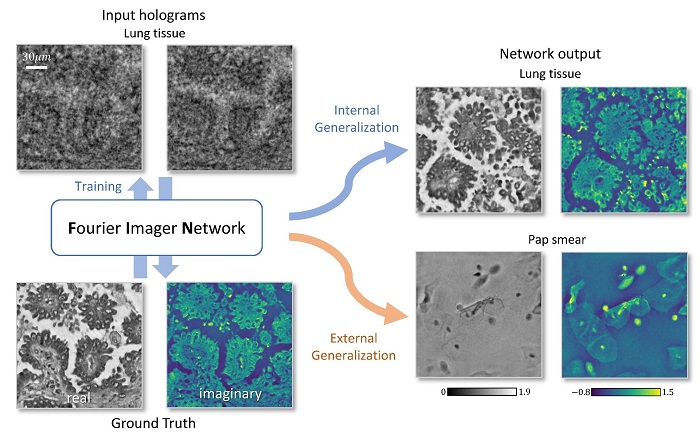
Deep learning has achieved benchmark results for various imaging tasks, including holographic microscopy, where an essential step is to recover the phase information of samples using intensity-only measurements. By training on well-designed datasets, deep neural networks have proven to outperform classical phase retrieval and hologram reconstruction algorithms in terms of accuracy and computational efficiency. However, model generalization, which refers to extending the neural networks’ capabilities to new types of samples never seen during the training, remains a challenge for existing deep learning models.
UCLA researchers have recently created a novel neural network architecture, termed Fourier Imager Network (FIN), which demonstrated unprecedented generalization to unseen sample types, also achieving superior computational speed in phase retrieval and holographic image reconstruction tasks. In this new approach, they introduced spatial Fourier transform modules that enable the neural network to take advantage of the spatial frequencies of the whole image. UCLA researchers trained their FIN model on human lung tissue samples and demonstrated its superior generalization by reconstructing the holograms of human prostate and salivary gland tissue sections, and Pap smear samples, which were never seen in the training phase.




The new deep learning-based framework is reported to achieve higher image reconstruction accuracy compared to the classical hologram reconstruction algorithms and the state-of-the-art deep learning models, while shortening the reconstruction time by ~50 times. This new deep learning framework can be broadly used to create highly generalizable neural networks for various microscopic imaging and computer vision tasks.
This research was led by Dr. Aydogan Ozcan, Chancellor’s Professor and Volgenau Chair for Engineering Innovation at UCLA and HHMI Professor with the Howard Hughes Medical Institute. The other researchers of this work include Hanlong Chen, Luzhe Huang, and Tairan Liu, all from the Electrical and Computer Engineering department at UCLA. Prof. Ozcan also has UCLA faculty appointments in the bioengineering and surgery departments and is an associate director of the California NanoSystems Institute.

