
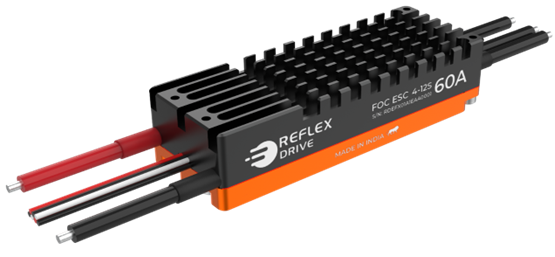
Reflex Drive, a deep tech startup from India has selected power devices from Infineon Technologies AG for its next-generation motor control solutions for unmanned aerial vehicles (UAVs). By integrating Infineon’s OptiMOS 80 V and 100 V, Reflex Drive’s electric speed controllers (ESCs) achieve improved thermal management and higher efficiency, enabling high power density in a compact footprint. Additionally, the use of Infineon’s MOTIX IMD701 controller solution which combines the XMC1404 microcontroller with the MOTIX 6EDL7141 3-phase gate driver IC delivers compact, precise, and reliable motor control. This enables improved performance, greater reliability, and longer flight times for UAVs.
“Our partnership with Reflex Drive is an important contribution to our market launch strategy and presence in India,” says Nenad Belancic, Global Application Manager Robotics and Drones at Infineon. “Our partner has proven its expertise with numerous customers who have obtained aviation certifications. In addition, the company has presented its innovative technologies enabled by Infineon systems at important international industry events.”




“Our collaboration with Infineon has led to significant advances in UAV electronics,” says Amrit Singh, Founder of Reflex Drive. “We believe drones have the potential to transform industries, from agriculture to logistics, and with Infineon’s devices, we can help drive this transformation at the forefront.”
Reflex Drives’s ESCs with field-oriented control (FOC) offer improved motor efficiency and precise control, while its high-performance BLDC motors are designed for optimized flight control and enable predictive maintenance of drive systems. Weighing only 180 g and with a compact volume of 120 cm³, the ESCs can deliver continuous power output of 3.8 kW (12S/48 V, 80 A continuous). Due to their lightweight design, robust power output, and consistent FOC control – even under demanding weather conditions – make them ideal for motors in the thrust range from 15 to 20 kg. Therefore, they are particularly suitable for drone applications in the fields of agricultural spraying technology, seed dispersal, small-scale logistics, and goods transport.

