
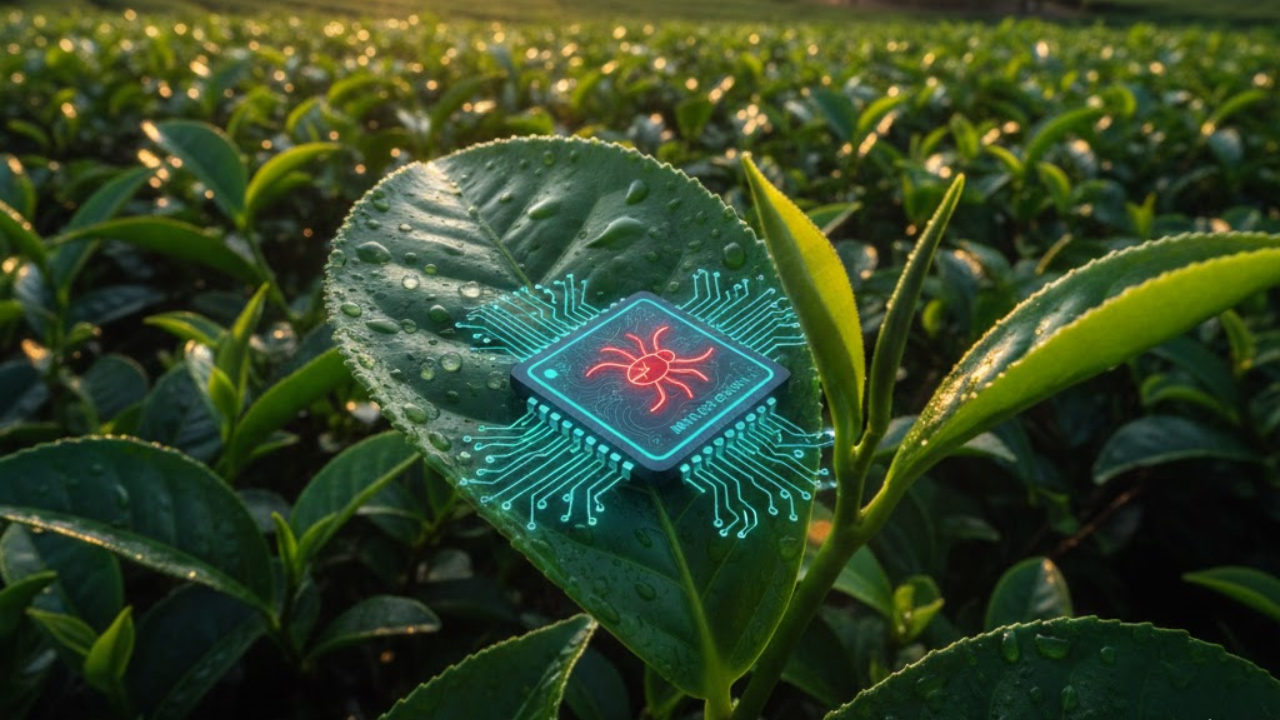
The North-Eastern Hill University (NEHU) in Meghalaya, developed an innovative indigenous semiconductor chip aimed at repelling the Red Spider Mite, one of the most destructive pests affecting the tea gardens across Northeast and other tea-growing regions in India.
This tech driven and eco-friendly innovation has been entirely developed at the Department of Electronics and communication Engineering, NEHU with collaborative research efforts of Pankaj Sarkar, Sushanta Kabir Dutta, Sangeeta Das, and Bhaiswajyoti Lahon.




The chip’s fabrication was undertaken at the Semiconductor Laboratory, Mohali, a premier Government of India facility for semiconductor manufacturing.
Currently, the semiconductor technology is relevant in the agricultural sector with regards to sensors, drone facilities, edge computing, IoT, and Artificial Intelligence. The development of technology has modernised the agricultural infrastructure to provide precision farming, and predictive analysis to boast yield.

