
Courtesy: Renesas
The Audio Pre-processing Front-end (APF) is an ultra-lightweight library of voice processing algorithms designed to enhance Voice Command Recognition (VCR) and speech quality in noisy environments. It utilizes acoustic noise suppression, which offers several benefits in voice command recognition, particularly in locations where significant levels of ambient noise typically interfere with VCR. Here are some key advantages:




- Improved Accuracy: Reducing background noise helps to isolate the voice commands more effectively, leading to higher recognition accuracy. This is crucial for ensuring the system correctly interprets user commands even under challenging acoustic conditions.
- Enhanced User Experience: With better noise suppression, users do not need to repeat commands multiple times, enhancing overall user experience; this is especially important in environments with high ambient noise levels.
- Increased Reliability: Noise suppression techniques improve the reliability of voice command systems by minimizing false positives and negatives, which ensures the system responds accurately to the intended commands and reduces the chances of misinterpretation.
- Energy Efficiency: In some systems, noise suppression can help reduce the processing load, leading to more efficient use of resources and potentially longer battery life for portable devices.
- Versatility: Acoustic noise suppression makes voice command systems more versatile and usable in a wider range of environments, from quiet rooms to noisy indoor and outdoor settings.
These benefits collectively contribute to a more robust and user-friendly Voice Command Recognition system, making it more effective and reliable in various real-world scenarios.
How does Audio Pre-processing work?
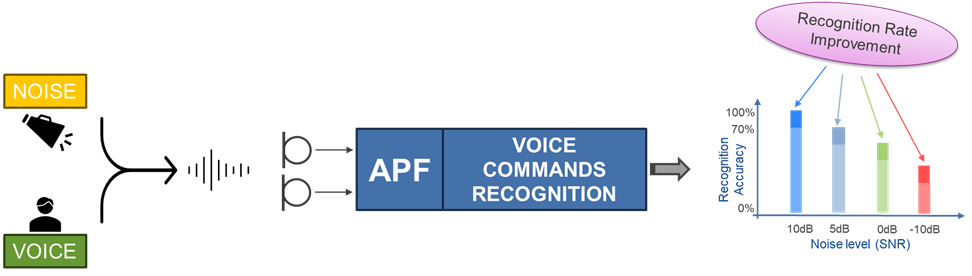
The Audio Pre-processing Front-end consists of two signal processing blocks set in tandem between the microphones and the voice command recognition unit. These are the acoustic beamforming that utilizes the combination of the two microphones attached in our example to the RA6E1 voice kit, RA8M1 voice kit, and the acoustic noise suppression that applies frequency selectivity attenuation to the areas where speech and noise coexist. In more detail:
- Acoustic beamforming is a technique used to improve the quality of audio signals by focusing on sounds coming from a specific direction while suppressing sounds from other directions. This is achieved by using an array of microphones and applying signal processing algorithms to combine the signals in such a way that the desired sound is enhanced and unwanted noise is reduced.
- Acoustic noise suppression, on the other hand, involves using algorithms to distinguish between the primary sound (like speech) and noise, then selectively removing or attenuating the noise components. This technique enhances audio clarity, especially in environments with significant ambient noise or in telecommunication systems.
As a result, the cascaded operation of the APF and VCR offers a distinguishable improvement in the recognition rate when the noise level becomes tough and reaches the level of the speech.
Renesas Application Example
The Renesas Audio Pre-processing Front-end is engineered in two application examples that are offered to evaluate the APF functionality. The first example combines the functionality of Cyberon’s DSpotter VCR and NLU enhanced with noise suppression from APF, hence it demonstrates the improvement in the quality of recognition accuracy when evaluated in noisy environments. The application example is offered as a project in e2 studio that can be loaded directly to the voice kit.
The second example is audio-related and combines APF with the USBx functionality that is offered in the Renesas FSP library for the RA family of devices. It demonstrates stereo audio recordings at 16KHz, while the processing of APF can be controlled through the onboard push button.
Conclusion
Audio Pre-processing Front-end operation plays a crucial role in enhancing audio signal quality by effectively managing noise distortions and improving the clarity of sound. APF techniques are particularly beneficial in environments with significant ambient noise, as they help in isolating the desired audio signals from those of the unwanted noise. By leveraging advanced algorithms, Renesas APF ensures that the primary sound source is accurately captured and reproduced, leading to a more reliable and high-fidelity audio experience. This technology is essential in various applications, including voice command recognition, telecommunication systems, and audio recording, where maintaining the integrity of the audio signal is paramount. Overall, the implementation of APF contributes to a more robust and user-friendly voice UI system, capable of delivering superior performance in diverse acoustic conditions.

