
By Falgun Jani, Business Head – India Region, Freudenberg Medical – FRCCI
The history of bioelectronics is visually characterised by a transition from early “animal electricity” experiments to sophisticated implantable and wearable technologies. As of today, the boundary between synthetic technology and biological systems is no longer a rigid barrier but a fluid, integrated interface. The field of bioelectronics has undergone a paradigm shift, moving away from “putting electronics in the body” toward “weaving electronics into the tissue”. This evolution is driven by the urgent clinical need for next-gen medical devices that can consistently monitor, diagnose, and treat diseases without triggering the body’s natural defence mechanisms.




Here is a brief history of the evolution of Bioelectronics:
Ancient & Early Modern Era (Pre-1800s)
- Ancient Medicine: As early as 2750–2500 BC, Egyptians used electric catfish to treat pain. Similar practices continued in Ancient Rome, using torpedo rays for gout and headaches.
- The Enlightenment: In the 1700s, scientists like Benjamin Franklin used electrostatic machines for medical experiments
The “Animal Electricity” Revolution (18th–19th Century)
- Luigi Galvani (1780): Often called the “father of bioelectronics,” Galvani observed frog legs twitching when touched with metal scalps, leading to the theory of “animal electricity”—the idea that tissues contain an intrinsic electrical fluid.
- Alessandro Volta (1800): Volta challenged Galvani, proving the twitching was caused by external metals and an electrolyte (the frog’s tissue). This disagreement led Volta to invent the voltaic pile (the first battery).
- Matteucci & Du Bois-Reymond (1840s): Carlo Matteucci proved that injured tissue generates electric current, while Emil du Bois-Reymond discovered the “action potential” in nerves.
The Rise of Implantable Technology (20th Century)
- First Electrocardiogram (1912): Initial references to bioelectronics focused on measuring body signals, leading to the development of the ECG.
- Cardiac Pacemakers (1950s–1960s):
1958: Rune Elmqvist and Åke Senning developed the first fully implantable pacemaker.
1960: The first long-term successful pacemaker was implanted in the U.S. by Wilson Greatbatch.
- Cochlear Implants (1961–1970s): William House performed the first cochlear implantation in 1961, and multichannel designs were commercialised by the 1970s.
- Glucose Biosensors (1962): Leland Clark and Lyons invented the first enzymatic glucose sensor, the foundation for modern diabetes management.
- Transistors & Miniaturisation: The 1960s saw the transition from bulky vacuum-tube devices to transistor-based implants, enabling the modern era of neuromodulation.
Modern Bioelectronic Medicine (21st Century)
- The Inflammatory Reflex (2002): Kevin J. Tracey discovered that the Vagus Nerve can regulate the immune system. This “eureka moment” launched the field of Bioelectronic Medicine, treating systemic inflammation (e.g., rheumatoid arthritis) with electrical pulses instead of drugs.
- Organic Bioelectronics (2010s–Present): Research shifted toward soft, flexible materials like conducting polymers and organic electrochemical transistors (OECTs) to better interface with human tissue.
The Global Bioelectronics Market size was estimated at USD 10.10 billion in 2025 and expected to reach USD 11.27 billion in 2026, at a CAGR of 12.31% to reach USD 22.78 billion by 2032, mainly driven by the rising prevalence of chronic diseases and the demand for personalised, patient-centric healthcare solutions.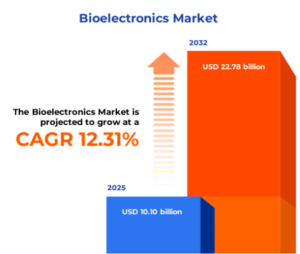
Key Applications in 2026 Healthcare
The integration of electronics into biocompatible substrates has led to a new class of medical devices that were once the domain of science fiction.
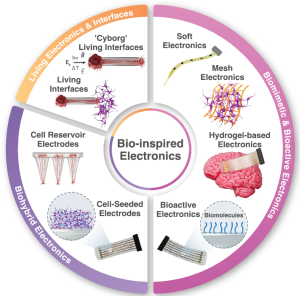
| Neural Interfaces and “Living Electrodes”. From simple deep brain stimulation, we are moving towards Biohybrid Neural Interfaces that use tissue-engineered axons to bridge the gap between a computer chip and the motor cortex. By “growing” biological wires into the brain, these devices achieve a level of chronic stability that allows paralysed patients to control robotic limbs with the same fluid precision as a biological arm.
Soft Bio-Sensing Wearables: Modern-day wearables have moved from the wrist to the skin. “Electronic skin” (e-skin) patches—ultrathin, breathable, and biocompatible—now monitor biochemical markers in sweat, such as cortisol and glucose, in real-time. These devices utilise MXenes and Graphene to detect molecular changes at concentrations previously only reachable via blood draws. |
| Closed-Loop Bioelectronic Medicine: The concept of “electroceuticals” is now a clinical reality. Small, biocompatible devices implanted on the vagus nerve can monitor inflammatory markers and automatically deliver precise electrical pulses to inhibit the “cytokine storm” associated with autoimmune diseases like rheumatoid arthritis and Crohn’s disease. |
Some key challenges remain to be resolved:
Engineering Challenges:
- Stability and Bio-Integration
Despite the progress, engineering the interface remains a complex task. The physiological environment is incredibly harsh—warm, salty, and chemically active—leading to the degradation of many synthetic materials.
- Hermetic Packaging vs. Biocompatibility
Engineers must find a critical balance between the need to seal sensitive electronics from moisture while ensuring the outer layer is soft enough to integrate with tissue. In 2026, atomic layer deposition (ALD) is used to create nanometer-thin ceramic coatings that provide moisture barriers without adding stiffness.
- The Power Problem
Traditional batteries are bulky and toxic. Next-generation devices are increasingly powered by biofuel cells that harvest energy from blood glucose or through ultrasonic power transfer, which allows deep-seated implants to be recharged wirelessly through layers of muscle and bone
Ethics and the Regulatory Challenges
- As we successfully integrate electronics into the human body, the ethical implications have shifted from “safety” to “agency and privacy.”
- The EU Medical Device Regulation (MDR) and the FDA’s Digital Health Centre of Excellence have established new frameworks for “Neural Data Privacy.”Since these devices can read and potentially influence neural states, the data they produce is classified as a biological asset.
- Furthermore, the longevity of these devices raises questions about “hardware obsolescence” in living patients. Engineering the interface now includes a roadmap for software updates and long-term support for implants that may stay in the body for decades.
The Future: Toward “Living” Bioelectronics
The trend is moving toward synthetic biology-electronics hybrids. We are seeing the prototypes of devices where genetically engineered cells that produce an electrical signal work as “Sensors” when they detect a specific pathogen or cancer marker.
By engineering the interface at the molecular level, we are not just repairing the body; we are enhancing its resilience.
The integration of electronics into biocompatible materials is more than a technical achievement—it is the foundation of a new era of personalised medicine where the device and the patient are the same.

