
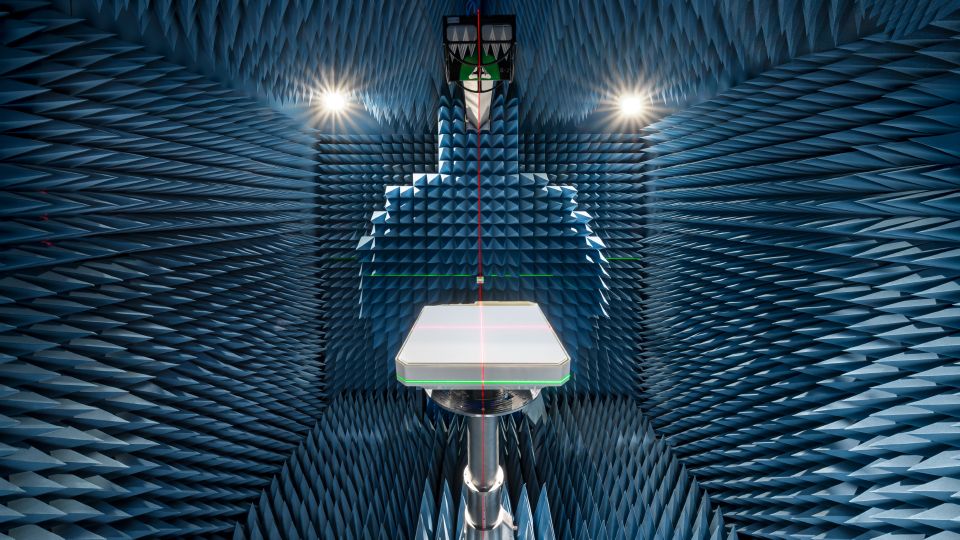
Rhode & Schwartz and Greenerwave conduct a joint measurement trial that demonstrates a near-field system. It can record the full radiation pattern of a 50 cm Ku band electronically steerable array for a SATCOM antenna in just half an hour. The result matches simulation models within a decibel, that make this approach rapid and precise. For manufacturers of SATCOM systems facing large chamber constraints, it offers a clear path towards quick and cost-effective testing.
Electronically Steerable Array (ESA) antennas are a key component in modern SATCOM systems. Accurate knowledge of their radiation pattern is required for reliable operation in LEO, MEO, and GEO orbits. However, conventional far-field testing demands chambers that are often larger for Ku or Ka band antennas, especially when the aperture of the Antenna Under Test (AUT) reaches half a meter or more. Compact Antenna Test Range (CATR) is relatively large for AUTs and are time consumiong dual-axis positioning of AUT to map the radiation pattern.




Greenerwave’s innovative SATCOM user terminals are based on Reconfigurable Intelligent Surface (RIS), allowing the company to design electronically steerable antennas that deliver high-performance connectivity while reducing energy consumption and reliance on semiconductors compared with conventional solutions.
For the joint measurement campaign, T&M expert Rhode & Schwarz provided its R&STS8991 over-the-air and antenna measurement system, equipped with a conical cut positioner, and its R&SZNA vector network analyser. Together, they evaluated Greenerwave’s passive single-aperture ESA that uses RIS technology for beamforming. The Antenna Under Test (AUT) features a 50x 50cm aperture and is designed for low power consumption and easy integration.
The measurement covered an extended upper hemisphere down to a polar angle of 120 degrees, using a one-degree step size. Ten Ku band frequencies were recorded in a total of 32 minutes due to the system’s hardware trigger function. Data was processed using the R&SAMS32 antenna measurement software, which applied the FIAFTA near-field to far-field transformation.
Comparison with the original simulation based on a numerical twin model and with results from Greenerwave’s CATR setup showed peak gain or directivity variations, validating the accuracy of the near-field solution. The trial shows that even large SATCOM antennas can be characterised quickly and accurately, providing a practical alternative to large-sized far-field CATRs. This system can be used by other SATCOM makers testing broadband, research lab environment, IoT for applications requiring flexible beam control and high data rates.

