

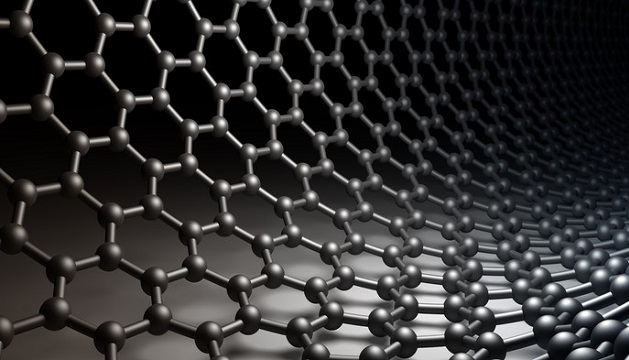
When we talk about Graphene, we can say that, it is a two-dimensional (2D) counterpart of graphite (carbon) material that has exceptional characteristics derived from the bonding characteristics of Carbon bonding sheets. It is an allotrope (form) of carbon consisting of a single layer of carbon atoms arranged in a hexagonal lattice. It is the basic structural element of many other allotropes of carbon, such as graphite, diamond, charcoal, carbon nanotubes and fullerenes. It can be considered as an indefinitely large aromatic molecule, the ultimate case of the family of flat polycyclic aromatic hydrocarbons.
Applications and Uses of Graphene used in Electronics:



Graphene has so many excellent properties and its extraordinary electron-carrying properties makes it eligible for making electronic components. Other properties of graphene helps in making the most of low-resistivity (in energy-saving power systems), and still others where excellent transparency and electrical conductivity are the important things (in solar cells and computer displays).
Graphene has a unique combination of properties that is ideal for next-generation electronics, including mechanical flexibility, high electrical conductivity, and chemical stability.
Flexible, stretchable and foldable electronics:
Flexible electronics depends upon bendable substrates and the foldable electronics require a foldable substrate with a stable conductor that can withstand folding. In addition to a foldable substrate like paper, the conductor that is deposited on this substrate also needs to be foldable. To that end, researchers have demonstrated a fabrication process for foldable graphene circuits based on paper substrates.
Photodetectors:
A demonstration has been conducted by the researchers that graphene can be used for telecommunications applications and its weak and universal optical response might be turned into advantages for ultrafast photonics applications. They also found that graphene could be potentially exploited as a saturable absorber with wide optical response ranging from ultra-violet, visible, infrared to terahertz, resulting into the rise of graphene in ultra-fast photonics.
Biotechnology and medicine:
According to a recent research, there is an opportunity found to replace antibiotics with graphene-based photothermal agents to trap and kill bacteria. In the decades-old quest to build artificial muscles, many materials have been investigated with regard to their suitability for actuator application (actuation is the ability of a material to reversibly change dimensions under the influence of various stimuli). Besides artificial muscles, potential applications include microelectromechanical systems (MEMS), biomimetic micro-and nanorobots, and micro fluidic devices. In experiments, scientists have shown that graphenenanoribbons can provide actuation.
Thermal management:
Graphene has an ability to conduct heat better than any other known material. Coolgraphene might be ideal for thermal management in nanoelectronics. Thermal interface materials (TIMs) are essential ingredients of thermal management and researchers have achieved a record enhancement of the thermal conductivity of TIMs by addition of an optimized mixture of graphene and multilayer graphene. Graphene has already set a new record as the most efficient filler for thermal interface materials.
Challenges of Graphenein Electronics:
There are a few factors that could slow the adoption of graphene. Such factors are:
Limited production volume: Although there are a rising number of methods of making various forms of graphene, the volume production for each of those methods stays low. One of the biggest challenges of the graphene industry will be to reach volume production in the next 2-5 years. The focus will have to be on material consistency and production cost.
Cost: Cost is an important factor in itself. Cost has come down considerably since the first commercial appearance of graphene. In the past two years, the price of sheet graphene has dropped to a third, while the price of powdered (including liquid) graphene went down to a quarter of its starting price. Still, the initial material cost is high, promoting applications that exploit multiple properties, and leading to initial adoption of high-margin applications.
Future of the Graphene Industry in Electronics:
There are factors which are expected to accelerate adoption of graphene. For instance, manufacturing and making available intermediate materials is crucial for moving graphene from a materials market to a components market. The challenge is to sift through the enormous body of novel graphene compounds and recognize the potential of a given compound for a specific application.
Processing graphene in the form which customers can easily integrate into their products is also a key challenge for the industry. In case of graphene films, for example, manufacturers will have to supply on a substrate which is readily integrated into the end-user process, or the user will have to grow the graphene in-house. In case of powdered forms of graphene, providing material that is compatible with current technologies of the chemical and polymer industry will be essential.
Niche applications with quick turnover that meet some unmet technology needs could also speed the adoption of graphene. For example, graphene could be used for DNA sequencing, membranes and filtration, in field-effect transistors for thermal management, photodetectors, OLEDs, etc.

